

If you’ve been arrested but not charged in Michigan, you’re in a strange and stressful legal limbo. It means a police officer believed they had enough reason to take you into custody, but the prosecutor hasn’t decided to formally press charges and start a court case against you.
You aren’t officially facing a criminal charge, and your case isn’t active in the court system. But—and this is a big “but”—it doesn’t mean you’re in the clear. The prosecutor can still file charges down the road.
Understanding the Difference Between an Arrest and a Charge
Most people think getting arrested automatically kicks off a criminal case. That’s a common, and frankly, dangerous, assumption. In Michigan’s legal system, an arrest and a formal charge are two completely separate events. A lot can happen in the gap between them.
An arrest is the first step, and it’s handled by the police. All they need is probable cause—basically, a reasonable suspicion that you might have committed a crime. Think of it like a movie producer optioning the rights to a book. There’s serious interest, but it’s no guarantee the movie is actually getting made. The big problem is that the arrest itself creates a public record, which is a whole other headache you’ll need to deal with. For a deeper dive into this standard, you can get more information on what is probable cause in the arrest context.
A criminal charge, on the other hand, is the official start of a court case. This decision is entirely up to the prosecuting attorney, not the police. The prosecutor is the gatekeeper. They review the police reports, look at witness statements, and analyze all the evidence to decide if the case is strong enough to even bother with.
If the prosecutor files a complaint, the movie gets the green light. If they decide not to, the whole project is scrapped before it ever starts.
Let’s break down the key differences in a table.
Arrest vs. Charge at a Glance
This table shows just how different these two stages are.
| Stage | Who Initiates It? | Legal Standard | What Happens Next? | Does It Appear on a Criminal Record? |
|---|---|---|---|---|
| Arrest | Police Officer | Probable Cause | Taken into custody, booked. Prosecutor reviews the case. | Yes, an arrest record is created. |
| Charge | Prosecuting Attorney | Evidence Beyond a Reasonable Doubt (prospect of winning at trial) | A formal complaint is filed. The court process (arraignment, etc.) begins. | Yes, the charge is added to your record. |
Understanding this distinction is the first step in protecting yourself. Just because you were arrested doesn’t mean you will be convicted—or even charged.
The Prosecutor’s Decisive Role
That gap between the arrest and the charge is a critical window. This is where prosecutorial discretion—the prosecutor’s power to decide—comes into play. A prosecutor in Kalamazoo, Grand Rapids, or anywhere in Southwest Michigan might look at a police report and decide not to move forward for a few common reasons:
- Not Enough Evidence: The police report might be thin, lacking the kind of solid proof needed to win a conviction in court.
- Witness Problems: Maybe the key witness is no longer cooperating, seems unreliable, or has completely changed their story.
- Legal or Procedural Mistakes: Sometimes the arresting officer messes up. An illegal search, a failure to read Miranda rights, or another procedural error can sink a case before it begins.
This is so important because it means your situation isn’t hopeless. An arrest doesn’t seal your fate. In fact, this period is a golden opportunity for an experienced defense attorney to get involved, present your side of the story, and persuade the prosecutor to drop the matter entirely.
What Happens After an Arrest in Michigan
Being arrested is a jarring experience. Once the handcuffs are on, the clock starts ticking, but the path forward isn’t always a straight line. That period right after an arrest is a critical window. It’s where your case can either steamroll into formal charges or get stopped dead in its tracks.
The first major checkpoint is your arraignment. If the police decide to hold you in jail, they can’t just leave you there indefinitely. The law says you have to be brought before a judge “without unnecessary delay.” While Michigan law doesn’t have a hard-and-fast deadline, this almost always happens within 48 to 72 hours.
But here’s the twist: getting released from jail doesn’t mean you’re in the clear. The prosecutor still has to decide whether to file charges, and that’s a whole different timeline. This phase, known as prosecutorial review, is the most important stage when you’ve been arrested but not yet charged.
The Prosecutor’s Review and Discretion
After your arrest, your case file—police reports, witness statements, evidence logs—lands on a prosecutor’s desk. This prosecutor, whether they’re in Kalamazoo, Grand Rapids, or a smaller office in Cass or St. Joseph County, is the ultimate gatekeeper. Their job is to review everything and decide if there’s enough evidence to actually take you to court.
Think of it this way: The police only need probable cause to arrest you, which is a relatively low bar. But the prosecutor has to believe they can prove your guilt beyond a reasonable doubt to a jury. That’s a much, much higher standard. It’s the reason a lot of cases fall apart before they even officially begin.
Prosecutors have a tremendous amount of power here, a concept called prosecutorial discretion. They can look at the file and simply decide not to charge the case. This happens more often than you’d think, for a handful of common reasons:
- Insufficient Evidence: The case is just too weak. Maybe it’s based on hearsay, or there’s no physical proof to back up the accusation.
- Witness Credibility Issues: The main witness might be unreliable, keeps changing their story, or has decided they don’t want to testify.
- Procedural Errors: The police might have messed up. A bad search, a failure to read you your Miranda rights—these mistakes can sink a case.
- Interests of Justice: Sometimes, it’s just not worth it. A prosecutor might decide that chasing a very minor offense isn’t a good use of the county’s time and money.
The infographic below shows this simple but crucial flow from the moment of arrest to the prosecutor’s big decision.
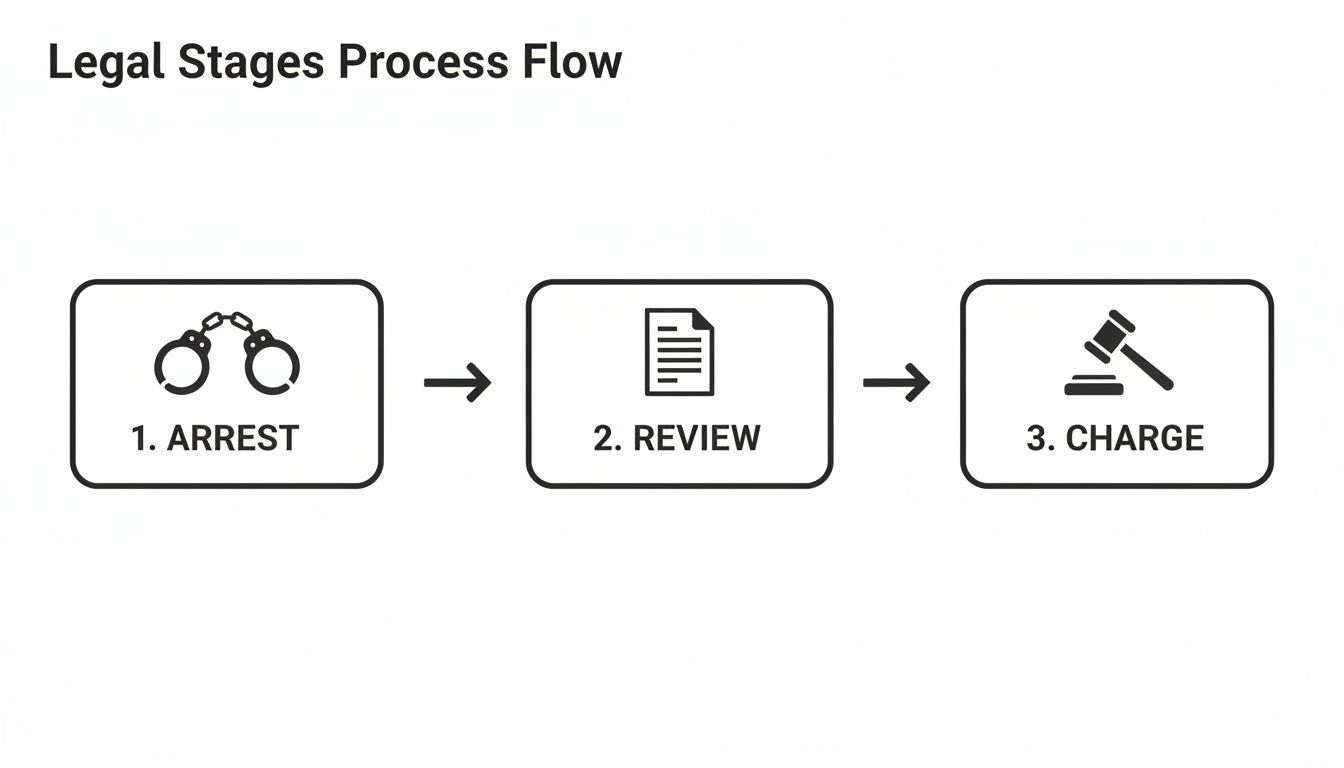
As you can see, that review stage is where everything can change. It’s the point where a solid defense can prevent a charge from ever seeing the light of day.
The Critical Window for Legal Intervention
This pre-charge period is, without a doubt, your best chance to get ahead of the problem. Just because you were released from jail doesn’t mean the threat is gone. The prosecutor can still file charges weeks or even months down the road, all the way up until the statute of limitations runs out. You can learn more by reading our article on how long police have to file charges in Michigan.
An experienced defense attorney can intervene during this exact window. By presenting exculpatory evidence, witness affidavits, or legal arguments directly to the prosecutor, an attorney can often persuade them to decline the case before it ever sees the inside of a courtroom.
This proactive approach is so much more effective than sitting back and waiting for a summons to appear in court. It gives your lawyer the opportunity to shape the narrative and poke holes in the police’s version of events before the prosecutor has made up their mind. For example, providing phone records that prove you were somewhere else or highlighting major inconsistencies in the arresting officer’s report can be incredibly persuasive. Taking action now isn’t an admission of guilt—it’s a smart, strategic move to shut the case down for good.
Immediate Steps to Take if Released Without Charges
That moment the jail doors open and you walk out without being charged feels like a massive weight has been lifted. But here’s a hard truth: it’s a huge mistake to think the whole ordeal is over. The time between your arrest and the prosecutor’s final decision is a critical window, and what you do—or don’t do—right now can be the difference between freedom and a formal charge.

This isn’t the time to sit back and hope for the best. It’s a chance to get on the offensive. You have a rare opportunity to build your defense before the prosecution has even decided to build its case. The first moves you make are absolutely essential for protecting your rights and your future.
Document Everything Immediately
Right now, your memory is as sharp as it’s ever going to be. Every detail, no matter how insignificant it seems, could be the key to your defense later on. As soon as you possibly can, sit down and write out a complete timeline of everything that happened.
Start at the very beginning—what you were doing before you even saw the police—and walk through the arrest, any questioning, and your release. Get as specific as you can.
- Who was there? Get the names and badge numbers of the officers if you can. Think about any witnesses who saw what happened.
- What was said? Try to recall the exact words exchanged between you and the police. Did they read you your Miranda rights? What questions did they ask you?
- Where did this happen? Note the precise location of the traffic stop, the arrest itself, and any searches that took place.
- When did it all go down? Write down the date and time of each key event in the sequence.
This written record becomes an invaluable tool for your attorney. It helps them spot procedural mistakes or find contradictions in the police report that could be used to your advantage.
Preserve Evidence and Stay Silent
Next up, lock down any evidence that backs up your story. This could be anything: text messages, call logs, photos, videos, or even receipts that prove where you were. Make copies and backups of any digital evidence right away.
And this part is crucial: resist the urge to talk about the arrest. Do not post a single word about it on social media. Don’t vent to friends or family. Any statement you make can be twisted and used against you if the prosecutor decides to file charges.
The only person you should discuss the details of your arrest with is your criminal defense attorney. Anything you say to them is protected by attorney-client privilege. Anything you say to anyone else—or post online—is potential evidence for the prosecution.
Consult a Michigan Criminal Defense Attorney
This is, without a doubt, the most important step you can take. You might be thinking, “Why do I need a lawyer? I wasn’t even charged.” The problem is, prosecutors in Michigan have until the statute of limitations runs out to file charges. Depending on the alleged crime, that could be months or even years down the road.
Hiring an attorney right away allows them to get involved during the prosecutor’s review period. An experienced lawyer can:
- Contact the Prosecuting Attorney: They can reach out to the prosecutor’s office, present your side of the story, and share any evidence that works in your favor.
- Poke Holes in the Case: A sharp attorney will scrutinize the police report for weaknesses, like a lack of probable cause for the arrest or a violation of your constitutional rights.
- Negotiate a Resolution: In some situations, a lawyer can persuade the prosecutor to drop the matter entirely or agree to a much less severe outcome before charges are ever filed.
Taking these steps changes the game. You go from being a passive person waiting for a decision to an active defender of your own rights. It’s the single best way to improve the odds that being arrested but not charged in Michigan never turns into a full-blown court case.
How an Arrest Without a Conviction Impacts Your Record

It’s one of the most dangerous myths in the Michigan criminal justice system: if you’re arrested but never charged, your record stays clean. That’s just not true. Believing it is a trap that can seriously jeopardize your future.
The moment you are arrested and fingerprinted, a public record is created. It doesn’t just vanish because a prosecutor decided not to move forward. Think of it like a hard inquiry on your credit report. Even if you never took out the loan, the inquiry stays there for a while. An arrest on your record works the same way, creating a permanent mark that can cause real problems down the road.
This happens a lot more often than people think. As Michigan’s criminal justice system evolves, factors like falling crime rates and prosecutors vetting cases more carefully mean more people are being arrested without ever being formally charged. Statewide arrests dropped a staggering 45.7%, from 320,774 in 2007 to just 174,095 in 2023. While specific Michigan data is hard to pin down, national trends suggest that anywhere from 15-25% of all arrests don’t lead to charges, and it’s a safe bet our state reflects that. You can dig into these trends in the latest MDOC report showing a continued decrease.
The Real-World Consequences of an Arrest Record
An arrest record, even without a conviction, can haunt you in very real ways. When you apply for a job, an apartment, or a professional license, background checks are standard practice. And while some checks only flag convictions, many of the more thorough ones will absolutely show arrests.
Put yourself in the shoes of a hiring manager in Grand Rapids. They’re looking at two equally qualified candidates. One has a totally clean record. The other has an arrest for retail fraud, even though it went nowhere. Who do you think gets the offer? The arrest alone can make you look like a risk.
Here are just a few of the doors a non-conviction arrest record can slam shut:
- Employment: Many employers, especially in sensitive fields like healthcare, finance, or education, might automatically disqualify you for having any kind of arrest history.
- Housing: Landlords can get nervous about renting to someone with an arrest on their record, worried about liability or other issues.
- Professional Licensing: In Michigan, boards that oversee professions like nursing, law, or real estate could question your moral character based on an arrest, potentially delaying or even denying your license.
- Educational Opportunities: Some universities and scholarship programs ask applicants to disclose arrests, which could impact everything from admissions to financial aid.
The bottom line is that an arrest record forces you to explain a difficult situation over and over again. It creates a shadow of suspicion that follows you, even when you haven’t been found guilty of anything.
Setting Aside Your Arrest Record in Michigan
The good news is that Michigan law provides a way to get out from under that shadow. The process of clearing an arrest that didn’t lead to a conviction is often called expungement, but the correct legal term is “setting aside.” It’s a powerful legal tool that lets you truly move on.
When an arrest is set aside, it’s removed from public-facing state records. For most background checks, it will be like the arrest never even happened. You get the legal right to say you were not arrested for that incident.
The Process for Clearing Your Name
To be eligible to set aside a non-conviction arrest in Michigan, a few things have to be true. Generally, the prosecutor must have officially declined to file charges, or the case must have been dismissed in court. You can’t have the arrest set aside if charges could still be filed—the statute of limitations needs to have run out, or the prosecutor has to formally close the case.
The process usually involves these steps:
- Filing a Formal Application: You have to file a detailed application with the court that would have handled the criminal charge.
- Fingerprinting: You’ll need to get a new set of fingerprints taken and sent to the Michigan State Police.
- Serving the Application: Copies of the application must be properly served on the Michigan Attorney General’s office and the police department that arrested you.
- A Court Hearing: A judge will review your application and the facts of your arrest to decide if setting it aside is in the public’s best interest.
While the steps might look straightforward on paper, the process demands absolute precision. One small mistake can cause major delays or even get your application denied. This is exactly why working with an experienced criminal defense attorney is so important. They make sure every form is filed correctly and can argue your case persuasively to the judge, highlighting why that old arrest is a problem that needs a real solution.
Your Legal Options for Clearing Your Name and Record
Just because the police let you go without charging you doesn’t mean you should just sit back and hope for the best. This is the perfect time to get proactive. Instead of just defending against charges that might come, you can go on the offensive, using Michigan law to wipe the slate clean and restore your reputation.
You have more control here than you probably think. From getting the police to destroy your arrest records to taking civil action for a wrongful arrest, a smart legal strategy is all about making sure this incident doesn’t hang over your head forever.
Demanding the Destruction of Your Arrest Records
One of the most effective things you can do when you’ve been arrested but not charged in Michigan is to have your records—fingerprints, mugshots, and all—destroyed. This doesn’t happen on its own. You or your lawyer have to formally ask the police department that arrested you to do it.
This is a big deal. It goes a step further than just getting a record set aside because it gets rid of the information at the source. Under Michigan law (MCL 28.243), if an arrest doesn’t lead to a conviction, those records aren’t supposed to be shared for things like background checks. But making a formal demand for destruction adds a much stronger layer of protection.
A lawyer can write a formal letter to the police department, pointing out that no charges were ever filed and demanding that they return or destroy:
- Fingerprints: Any digital or ink copies taken when you were booked.
- Arrest Card: The internal police document that officially created the arrest record.
- Photographs: All mugshots taken during the arrest process.
Taking this step is vital. It helps prevent your information from just sitting in some local database where it could be improperly accessed or shared down the road.
Pursuing Civil Claims for Wrongful Detention
Sometimes, the arrest itself was illegal from the get-go. If the police arrested you without probable cause or violated your civil rights in the process, you might have a case for a civil lawsuit. This is about seeking financial compensation for the harm caused by being wrongfully locked up.
It’s important to be realistic, though. The legal bar for these cases is incredibly high, and they don’t apply to every situation where charges are dropped. In Michigan, plenty of people are arrested but never charged because of prosecutorial discretion. That’s just a prosecutor deciding the evidence is too weak to move forward, which doesn’t automatically mean the arrest was illegal. National data suggests this happens in about 20-30% of misdemeanor arrests, and we see a similar pattern here in Michigan.
Two of the most common civil claims are:
- False Arrest: This is when you argue the police had no legal reason (probable cause) to arrest you in the first place.
- Malicious Prosecution: This one is much tougher to prove. You have to show not only that there was no probable cause, but that the case was brought against you with malice and was ultimately decided in your favor.
Filing a civil lawsuit is a serious move. A seasoned attorney can dig into the specifics of your arrest and tell you straight up whether the police crossed a legal line. For more in-depth information on legal processes and your rights, consider exploring various legal resources.
Taking these proactive steps is about more than just dodging a criminal conviction. It’s about protecting your future—your career, your reputation, and your peace of mind. If you’ve already been convicted and want to clear your record, you can also check out our guide on getting a criminal conviction expunged in Michigan.
Why a Local Defense Attorney Is Your Best Ally
When you’re arrested but not charged in Michigan, the legal system can feel like a maze with its own set of unspoken rules. Trying to find your way through it alone is a huge risk, but having a guide who knows the shortcuts, the dead ends, and the people making the decisions can change everything. This is where a local defense attorney, especially one with deep roots in Southwest Michigan’s courts, becomes your most powerful advantage.
This isn’t about just finding any lawyer. It’s about hiring an advocate who gets the specific tendencies of the prosecutors in places like Kalamazoo, Grand Rapids, and the surrounding counties. Those local relationships and insights are priceless. An attorney who has spent years in these courtrooms knows which arguments land best with which prosecutors and judges.
The Prosecutor’s Playbook
An attorney with a background as a prosecutor brings an even bigger edge to the table. They’ve been on the other side. They understand the internal pressures, evidence standards, and negotiation tactics that prosecutors rely on every single day. This insider knowledge lets them anticipate the prosecution’s next move and build a counter-strategy before charges are even filed.
Take a potential OWI case, for example. A seasoned attorney knows exactly what weaknesses to hunt for in the police report—from mistakes in the field sobriety tests to issues with the breathalyzer’s calibration. They can point these flaws out to the prosecutor during that crucial review period, making a strong case that the evidence is just too weak to win at trial.
Hiring a defense attorney early is not an admission of guilt. It is a strategic, proactive step to protect your rights and work toward the best possible outcome—getting the case dismissed before it even starts.
Pre-Charge Intervention in Action
This early intervention is where a local attorney really shows their value. For instance, people being investigated for drug or weapons offenses often see their cases dropped before a formal charge is ever issued, but only when a skilled lawyer gets involved early. For our clients in Portage and Grand Rapids, this kind of pre-charge advocacy is frequently the key to success. In a high-scrutiny environment where some Michigan prosecutors are focused on boosting case closure rates, more arrests are getting filtered out before they ever become formal charges. Discover more insights about Michigan’s justice system trends.
When you start working with a defense attorney, it’s critical to provide them with all the necessary information, which often starts with filling out legal client intake documents. A local attorney can quickly size up the evidence against you and present a compelling argument to the prosecutor, highlighting weak spots or constitutional violations. This decisive action can be the one thing that convinces the prosecutor to drop the case, saving you the stress, cost, and public record of a formal criminal charge.
Common Questions After a Michigan Arrest Without Charges
Being arrested and then released without any charges filed can leave you in a confusing and stressful gray area. It’s a situation that, naturally, sparks a lot of urgent questions. Here are some straightforward answers to the things people worry about most in this exact scenario.
How Long Can the Prosecutor Wait to File Charges After an Arrest?
This is probably the biggest source of anxiety—the waiting. How long do they have to decide? There’s no simple 30-day or 60-day rule. The answer is tied to Michigan’s statute of limitations, which is basically a deadline for prosecutors to bring a criminal case. The specific deadline depends entirely on how serious the potential crime is.
- Most Misdemeanors: For less serious offenses, a prosecutor typically has one to two years to file charges.
- Many Felonies: The window gets much wider for felonies, often extending to six years or more.
- Serious Crimes: For the most severe crimes, like murder, there’s no deadline at all.
This is exactly why you can’t just assume you’re in the clear because you were let go. A good criminal defense lawyer can look at the specific situation and tell you precisely what deadline the prosecutor is up against.
Will an Arrest Without Charges Show Up on a Background Check?
Yes, and this is a huge misunderstanding that can cause serious problems down the road. The moment you are fingerprinted and booked, an arrest record is created. It’s now a public record. Even if the prosecutor ultimately decides not to file charges, that arrest record doesn’t just vanish on its own.
This record can absolutely show up on the detailed background checks used for jobs, professional licenses, or even apartment applications. A potential employer might see the arrest and, not knowing the full story, simply decide to go with a different candidate. It’s a perfect example of why you need to be proactive about getting the arrest set aside to truly clear your name.
What if the Police Contact Me Again After I’ve Been Released?
If an officer or detective calls you for “just a few follow-up questions” after you’ve been released, you have one job: protect yourself. You should politely but firmly use your right to remain silent and state that you will not answer any questions unless your lawyer is present.
Anything you say—no matter how innocent it seems—can be twisted and used to build a case against you. The only right way to handle it is to say, “I will not speak with you without my attorney,” and then stop talking. Let your lawyer take over all communication from that point on. It’s the only way to be sure you don’t accidentally give them the evidence they need.
Can I Get My Seized Property Back?
If the police took personal property from you during the arrest—your phone, your car, or cash—you have a right to get it back if charges aren’t filed. But this almost never happens automatically. The police often hold onto items they think could be evidence.
An experienced attorney knows how to cut through the red tape. They can file the right legal motions and deal directly with the police department or prosecutor’s office to speed up the return of your property.
If you’ve been arrested in Michigan, the best thing you can do is act fast to protect your future. The legal team at David G. Moore, Attorney at Law has the experience to get involved early and fight to make sure charges are never filed in the first place. Contact us today for a consultation to discuss your case.


