

Let’s cut right to the chase: In Michigan, a judge cannot pull your bond for “no reason.” Period. The law is very clear on this. Your freedom before trial is protected, and taking it away requires a specific, proven violation of your release conditions.
Think of your bond agreement like a contract. You promise to show up for court and follow the rules, and in return, you get to stay out of jail while your case proceeds. Just like a landlord can’t evict you on a whim, a judge can’t just change their mind and lock you up without a legitimate, legally recognized reason.
Why a Michigan Bond Cannot Be Revoked Without Cause
When a court grants you bond, it’s extending a form of conditional trust. That trust is built on your promise to follow the judge’s orders and appear for every scheduled court date. To revoke that trust—and your freedom—is a serious step, and the Michigan justice system is designed to prevent it from happening lightly. The entire process rests on the foundation of due process, which means actions must be fair and follow established rules, not just a judge’s or prosecutor’s personal feelings.
The core principle is simple: there must be cause. A prosecutor can’t just decide they made a mistake in agreeing to your bond, and a judge can’t revoke it based on a gut feeling. They have to come to court with evidence showing you failed to hold up your end of the bargain.
The Role of Due Process
This demand for a valid reason is a cornerstone of your constitutional rights. It stops the court system from being unpredictable and ensures your liberty isn’t taken away arbitrarily. In the context of bond revocation, due process guarantees you a fair fight. You have the right to:
- Receive a formal notice explaining the specific violation you’re accused of.
- Get a hearing where the prosecutor has to prove you actually committed that violation.
- Have a lawyer by your side to challenge the accusations and defend you.
This structured procedure is a safeguard, ensuring any decision is based on facts and evidence, not suspicion. A 2023 review of cases in Southwest Michigan courts, including those in Kalamazoo and Cass Counties, showed that over 70% of bond revocation requests were shot down when the prosecutor couldn’t provide documented proof of a violation. This data confirms that judges take these protections seriously. If you’re looking for more background, you can learn about the key differences between bond and bail in Michigan from this detailed guide.
The system is designed to prevent ‘no reason’ revocations. A judge must hold a hearing and find that it is more likely than not that a violation occurred before they can legally send you back to jail.
Lawful vs. Unlawful Reasons for Bond Revocation
It’s crucial to understand what counts as a legitimate reason for a judge to revoke bond versus what doesn’t. The table below breaks down some common scenarios to illustrate the difference.
| Basis for Revocation | Example | Is This Lawful in Michigan? |
|---|---|---|
| Violating a “No Contact” Order | The defendant sends a text message to the alleged victim in a domestic violence case. | Yes. This is a direct and provable violation of a common bond condition. |
| New Criminal Allegations | The defendant is arrested and charged with a new crime while out on bond. | Yes. Committing a new offense is a clear breach of the agreement to remain law-abiding. |
| Prosecutor’s Second Thoughts | The prosecutor simply decides the initial bond amount was too low. | No. This is not a violation by the defendant. The prosecutor must file a motion to modify bond, not revoke it without cause. |
| Missing a Court Date | The defendant fails to appear for a scheduled pretrial conference. | Yes. Failing to appear (FTA) is one of the most common and serious reasons for bond revocation. |
| Failing a Drug/Alcohol Test | The defendant tests positive for alcohol, violating a condition to abstain from drinking. | Yes. If sobriety is a condition of release, a failed test is a clear violation. |
| “Bad Feeling” from the Judge | The judge hears a rumor or just feels the defendant might be a risk, with no new evidence. | No. Judicial decisions must be based on facts and evidence presented in court, not on intuition or hearsay. |
As you can see, the lawful reasons all point back to a specific action—or inaction—by the defendant that breaks the rules they agreed to follow. Anything else is likely an overstep of the court’s authority.
Understanding Your Bond and Its Conditions
Before we can talk about why a bond might get revoked, we need to be crystal clear on what a bond actually is. In simple terms, it’s a contract with the court. When you post bond—whether it’s with cash, property, or a bail bondsman—you’re making a formal promise to show up for all your future court dates.
But it’s more than just a promise to appear. Your bond comes with a specific set of rules, known as bond conditions, that you absolutely must follow while your case is pending. Think of them as the “terms and conditions” of your freedom. Violating any one of them gives the judge a legitimate, legal reason to put you back in jail.
The Purpose of Bond Conditions
A judge doesn’t just pull these conditions out of thin air. Each rule is there for a specific reason, usually boiling down to two main goals: making sure you come back to court and keeping the public safe.
The conditions are supposed to be tailored to the facts of your case, your background, and the specific charges you’re facing. For instance, someone on their first retail fraud charge will have a very different set of rules than someone with a history of OWI/DUI offenses. The court tries to use the least restrictive conditions possible to achieve its goals—it’s not about punishing you before a conviction. This is a big part of why a bond can’t be revoked for no reason; the revocation has to be directly linked to breaking one of these established rules.
Bond conditions aren’t random punishments. They are specific, court-ordered rules designed to manage risk and ensure the judicial process can proceed smoothly while you remain out of custody.
Common Bond Conditions in Michigan
While the specifics can change from case to case, there are several common conditions you’ll see in bond orders across Michigan, from Kalamazoo to Grand Rapids. Knowing what’s expected of you is the first and most important step to staying out of trouble.
Here are some of the rules you’re most likely to see:
- Regular Check-Ins: This could mean calling or visiting a pretrial services or probation officer on a regular schedule, like once a week.
- No-Contact Orders: A big one in assault or domestic violence cases. It means zero contact with the alleged victim—no texts, no calls, no social media DMs, and no asking friends to pass along a message.
- Substance Abuse Testing: If your charge involves drugs or alcohol (like a DUI), you can expect to be ordered to stay clean and submit to random drug or alcohol tests.
- Travel Restrictions: You’ll likely be forbidden from leaving Michigan, or sometimes even your own county, without getting the court’s permission first.
- GPS Tethering: For more serious charges or if the judge thinks you might be a flight risk, you could be ordered to wear an electronic monitoring device (a tether) that tracks your location 24/7.
Any slip-up with these rules can lead to the prosecutor filing a motion to revoke your bond. If you’re working with a third-party agent, it’s also helpful to understand their role. For a closer look at that process, check out our guide on what a surety bond is in jail. The bottom line is this: treat your bond as a serious agreement with clear rules, because that’s exactly what it is.
What Are Legitimate Reasons for a Judge to Revoke My Bond?
While it’s true that a judge in Michigan can’t just revoke your bond for no reason, they don’t need much of one if you’ve broken the rules. When you’re released on bond, you’ve essentially made a deal with the court. The judge is trusting you to follow a specific set of conditions, and any misstep can be seen as a breach of that trust.
Think of your bond conditions as the absolute, must-follow rules of your temporary freedom. If you violate one of them, the prosecutor is going to flag it for the judge, and your freedom will be on the line.
Missing a Court Date
This is the big one. Your single most important promise to the court when you were released was to show up for every single hearing. Failing to appear—often called an FTA—is a direct slap in the face to that promise.
It doesn’t matter if you overslept, your car broke down, or you simply forgot. The moment you miss a court date, the judge will almost certainly issue a bench warrant for your arrest. Once you’re picked up on that warrant, you can bet the prosecutor will argue you’re a flight risk who can’t be trusted, making a powerful case to keep you locked up until your case is over.
Getting Charged with a New Crime
Another fast track to jail is getting arrested for something new while you’re out on bond. A core condition of every bond is simple: don’t break any more laws. A new charge tells the judge that you either can’t or won’t stay out of trouble, and that you might be a danger to the public.
Imagine you’re out on bond for a shoplifting charge and then get pulled over and arrested for drunk driving. The prosecutor in your first case will immediately file a motion to revoke your bond. Their argument is simple: your new arrest shows you have no respect for the court’s authority and pose a risk to the community.
Committing a new offense while on bond is one of the quickest ways to lose it. The court’s two main goals are ensuring public safety and making sure you show up to court. A new charge convinces them you’re a risk on both fronts.
Violating a No-Contact Order
No-contact orders are incredibly common, especially in domestic violence, assault, or stalking cases. And they are absolute. This means zero contact of any kind—no calls, texts, emails, social media messages, or even asking a friend to pass along a message for you.
Here’s the critical part: it doesn’t matter who starts it. If the person you’re supposed to stay away from texts you first and you reply, you are the one who violated the order. They won’t get in trouble, but you absolutely can have your bond revoked and be put back in jail.
Failing a Drug or Alcohol Test
If your bond conditions include staying away from drugs or alcohol, you’ll be subject to random testing. A positive test is a black-and-white violation. This is a standard condition in nearly all OWI/DUI cases and, of course, any case involving drug charges.
From the court’s perspective, a failed drug or alcohol test is proof that you’re ignoring a direct order and likely continuing the very behavior that got you in trouble in the first place. This is a very frequent reason for bond revocation hearings, especially in courts around Kalamazoo and Grand Rapids, which are known for taking these violations seriously.
Other common actions that will land you in hot water include:
- Tampering with a GPS Tether: If you have an electronic monitor, trying to remove it, cut it off, or interfere with the signal is a major violation.
- Failing to Check In: Many bonds require you to check in with a pretrial services officer. Missing these appointments is a surefire way to trigger a violation.
- Leaving the State: Your bond almost always restricts travel. If you leave Michigan without getting the judge’s permission first, you’ve violated your conditions.
At the end of the day, any failure to follow your court-ordered rules gives the prosecutor the ammunition they need to try and put you back in jail. The only way to protect your freedom is to know every single one of your conditions and follow them perfectly.
What to Expect During the Bond Revocation Process
Getting accused of violating your bond is a gut-wrenching experience. That feeling of uncertainty—not knowing what the court will do next—can be completely overwhelming. The best way to regain some control is to understand the court’s playbook. Knowing the step-by-step process for a bond revocation can take away some of the mystery and help you prepare for what’s coming.
It’s important to realize this isn’t a new trial for your original criminal charge. It’s a separate, focused set of events designed to answer just one question: did you break the rules of your release? Knowing these stages helps you and your attorney build the strongest possible response.
The Prosecutor Files a Motion to Revoke Bond
The whole thing usually kicks off with the prosecutor. When someone—a bond agent, a pretrial services officer, or even the police—reports a potential violation, that report lands on the prosecutor’s desk. This could be anything from a missed check-in to a failed drug screen.
If the prosecutor finds the report credible, they’ll file a formal document called a Motion to Revoke Bond. This paper lays out exactly what they think you did wrong and officially asks the judge to take you off the street. Think of it as the starting pistol for the entire revocation process.
The Court Issues a Warrant for Your Arrest
Once that motion is filed, the judge will almost always sign a bench warrant for your arrest. This isn’t a warrant for a new crime; it’s a direct order for law enforcement to find you and bring you to court to answer for the alleged violation.
You might learn about the warrant the hard way—with police showing up at your door or during a routine traffic stop. It’s a jarring and public way to be taken into custody. This is exactly why it’s so critical to call an attorney the second you even suspect there’s a problem. A lawyer can often arrange for a safe and dignified surrender, helping you avoid a sudden and stressful arrest. Just as specific steps are required to initiate or respond to a bond revocation, understanding the formal process to how to void a power of attorney can provide insight into legal termination procedures.
This flowchart shows some of the most common mistakes that trigger this whole chain of events.
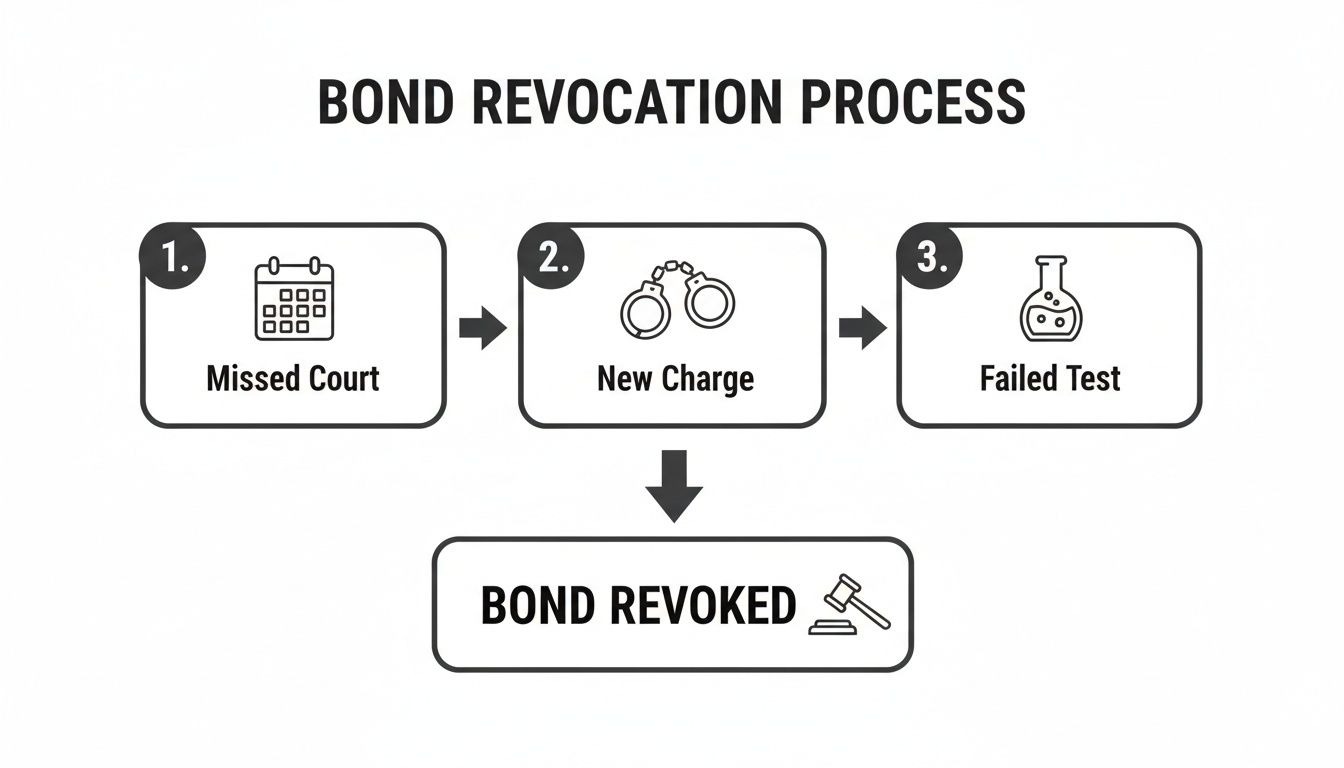
As you can see, simple but serious slip-ups like missing a court date, getting new charges, or failing a test are direct pathways to a bond revocation hearing.
The Critical Bond Revocation Hearing
After you’re arrested on the warrant, you’ll be brought back to court for the revocation hearing. This is your chance to fight the allegation. Here’s a quick rundown of what happens:
- Arraignment on the Violation: First, the judge reads the alleged violation out loud and asks you for your plea—guilty or not guilty to the violation.
- The Prosecutor’s Case: If you plead not guilty, the prosecutor has to put on their evidence. This is usually much less formal than a trial. They might just call your pretrial officer to the stand or submit a lab report from a test.
- Your Defense: This is your attorney’s turn. They can cross-examine the prosecutor’s witnesses and present your side of the story. Maybe you have a legitimate reason for the missed check-in, or perhaps the test result was a false positive.
Here’s the key difference: the standard of proof is much, much lower than in a criminal trial. The prosecutor doesn’t need to prove you violated your bond “beyond a reasonable doubt.” They only have to show it was “more likely than not.” That’s a far easier hurdle to clear.
The bond revocation hearing is not about proving your guilt or innocence on the main charge. It is a focused proceeding to determine if you broke the rules of your pretrial release.
The judge’s decision at this hearing will determine whether you spend the rest of your case in jail or out on bond. It’s a high-stakes moment where having an experienced attorney is absolutely essential. To learn more about how these court appearances can play out, check out our guide on whether you can go to jail at a review hearing: https://dgmoorelaw.com/blog/can-you-go-to-jail-at-a-review-hearing/.
Fighting for Your Freedom at a Revocation Hearing
Just because the prosecutor accuses you of violating your bond doesn’t mean it’s a done deal. You’re not automatically going back to jail. The law guarantees you a fair shake and the chance to defend yourself in court. This isn’t the trial for your main criminal charge; it’s a specific, focused hearing where your rights are front and center.
Think of it as a mini-trial focused entirely on one thing: the alleged violation. You don’t have to simply roll over and accept what the prosecutor says. You have every right to push back, present your own side of the story, and fight to stay out of jail while your case proceeds.
Understanding Your Core Rights
When you step into that courtroom for a bond revocation hearing, you’re protected by several key legal rights. Knowing what they are is the first and most critical step in building a solid defense.
Here’s what you are legally entitled to:
- The Right to Be Notified: The court can’t just spring this on you. You must receive a formal, written notice that clearly states what specific rule they claim you broke.
- The Right to an Attorney: You have the absolute right to have a lawyer by your side. This is vital because the legal rules and standards in these hearings are different from a regular trial, and an experienced attorney knows how to navigate them.
- The Right to Be Present and Heard: You get to be in the courtroom, face your accuser, hear all the evidence against you, and tell your side of the story. They can’t hold the hearing without you.
- The Right to Challenge Evidence: This is a big one. Your lawyer can cross-examine the prosecutor’s witnesses and pick apart their evidence, whether it’s a questionable lab report or a police officer’s testimony.
These rights are the bedrock of a fair hearing. Without them, it would just be the prosecution making claims with no one to challenge them.
The burden of proof in a bond revocation hearing lies squarely with the prosecution. You don’t have to prove you’re innocent of the violation; they have to prove it’s “more likely than not” that you actually violated a condition of your release.
This legal standard, known as a preponderance of the evidence, is lower than the “beyond a reasonable doubt” standard needed to convict you of a crime. Still, it means the prosecutor has to bring real evidence to the table. They can’t get your bond revoked based on a gut feeling, a rumor, or hearsay.
Why a Defense Attorney is Not Optional
Trying to handle a revocation hearing on your own is a huge gamble. The rules of evidence are often looser than in a trial, and as we just saw, the prosecutor’s burden of proof is lower. All of this makes it much easier for them to win. A sharp defense attorney is your single most important ally in this fight. While you can use tools like an AI legal assistant to help organize case documents, it’s no substitute for professional legal counsel.
An experienced lawyer can shield you in several crucial ways:
- Picking Apart the Prosecutor’s Case: They will scrutinize every piece of evidence for weaknesses. Was that failed drug test actually a false positive from a prescription medication? Was that missed check-in with your officer because you were in the ER with a documented medical emergency? These are the kinds of questions a lawyer knows to ask.
- Telling Your Side of the Story: Your attorney can present evidence and call witnesses on your behalf. This could be anything from a letter from your boss confirming you were at work to testimony from a family member who can vouch for your whereabouts.
- Negotiating for a Second Chance: Even if it’s clear a minor violation happened, a good attorney can often negotiate a better outcome than being locked up. They might be able to argue for stricter conditions (like a GPS tether), a higher bond amount, or mandatory counseling instead of outright revocation.
Without a lawyer, you’re at a serious disadvantage. You’re up against a prosecutor who lives and breathes this system, in front of a judge who has to make a quick decision based only on what’s presented. Your attorney’s job is to make sure your story is part of that presentation—told clearly, persuasively, and effectively.
What to Do If You Are Accused of Violating Bond
Getting a call that you’ve been accused of violating your bond is a gut-wrenching experience. That first wave of panic and confusion is real, but what you do in the next few hours is absolutely critical. Taking swift, smart action is the best way to protect yourself and start fighting the allegation.
Your very first move—before you do anything else—is to contact an experienced criminal defense attorney. This is not a DIY situation. An accusation of a bond violation is a legal emergency, and delaying that call can have disastrous consequences, often resulting in an immediate warrant for your arrest.
Take Proactive Steps Immediately
As you’re reaching out to a lawyer, you can take a few key steps to start building your defense. Time is ticking, so it’s important to act quickly and gather your thoughts.
First, collect any and all evidence that supports your version of events. Think creatively here. This could be anything that proves where you were or what you were doing.
- Text messages or call logs that provide an alibi or crucial context.
- Receipts from a gas station, store, or restaurant that can pinpoint your location at a specific time.
- Photos or videos with timestamps.
- The names and phone numbers of anyone who was with you and can act as a witness.
Next, while it’s all fresh in your mind, write down a detailed timeline of what happened. Be specific. Include dates, times, locations, and a summary of any conversations you had. This written account will be an incredibly valuable tool for your attorney as they start piecing together your defense.
The single most important rule right now is to avoid discussing the situation with anyone except your lawyer. Don’t talk to the police, the prosecutor, your bondsman, or even the alleged victim without your attorney present. Anything you say can be twisted and used against you in court.
Preparing for Your Day in Court
Once you have a lawyer in your corner, they will take the lead. They’ll get a copy of the prosecutor’s motion to revoke your bond and dig into the specifics of the allegation. This is where a good attorney shines—they look for the weak spots in the prosecutor’s case and start building a strategy to attack them. For instance, if you’re accused of leaving town, your lawyer will immediately ask if you had permission. You can learn more by reading our guide about leaving the state on bond.
While your defense must be led by a qualified attorney, support tools can sometimes help organize information. For example, some legal teams use an AI legal assistant to quickly review documents and help structure arguments. But remember, these are just tools; they’re no substitute for the experience of a lawyer who knows Michigan law inside and out.
The goal is to walk into that hearing with a strong, evidence-based argument that explains to the judge why your bond should stay in place. Whether that means proving the accusation is completely false or showing that a minor slip-up was an honest mistake, the steps you take now—combined with your lawyer’s expertise—are your best defense. So while the answer to “Can a bond be revoked for no reason in Michigan?” is a clear no, you have to be ready to fight a bad reason.
Common Questions About Michigan Bond Revocation
Walking through the bond system can feel like navigating a maze, and the threat of having your bond revoked adds a whole new layer of stress. Let’s clear up some of the most pressing questions people have when they’re facing a potential bond violation here in Michigan.
If My Bond Is Revoked, Will I Get My Money Back?
In nearly every case, the answer is no. When a judge revokes your bond because you broke one of the conditions, the court keeps the money. This is true whether you posted a 10% cash bond directly with the court or paid a fee to a bail bondsman for a surety bond.
Think of it this way: the bond money was your promise to the court that you’d follow all the rules. When a condition is violated, the court sees it as a broken promise, and the financial guarantee is forfeited.
Can Something Minor Really Get My Bond Revoked?
Yes, it absolutely can. While some judges might give you a pass for a single, minor slip-up—say, you were ten minutes late to a check-in because of a flat tire—many others have a zero-tolerance policy. What seems like a small mistake to you could easily be enough for the prosecutor to file a motion to revoke your bond.
This is exactly where having an experienced attorney makes a world of difference. Your lawyer can get out in front of the problem, contacting the pretrial services officer or the prosecutor to explain what happened. They can show that it was an honest mistake backed by proof, like a tow truck receipt, rather than a willful violation. This kind of proactive work can sometimes stop a formal revocation hearing from ever being scheduled.
Don’t assume a minor violation will have a minor consequence. The outcome often hinges on the specific judge, the prosecutor’s stance, and how effectively your attorney presents your side of the story.
Is Bond Revocation Automatic if I’m Arrested for a New Crime?
It’s not technically “automatic,” but it’s about as close as you can get. Getting arrested for a new crime while out on bond is one of the most serious violations possible. The court’s two main jobs are to make sure you show up for your court dates and to protect the public.
A new arrest screams to the judge that you might be a danger to the community. Your defense attorney’s job becomes crucial at this point. They can argue for other options, like a much higher bond amount or adding a GPS tether, but you need to be ready for the very real possibility that you’ll be held in jail until your original case is finished.
How Long Does a Bond Revocation Hearing Take?
These hearings are usually fast. We’re not talking about a full-blown trial; most are wrapped up in 15 minutes to an hour, though the exact time depends on what you’re accused of doing.
For instance, a hearing over a positive drug test might be quick. The prosecutor just needs to present the lab results. But if the issue is an alleged violation of a no-contact order, it could take longer. That kind of hearing might involve testimony from the police, the person you were ordered to stay away from, and other witnesses.
If you or someone you care about is facing an accusation of a bond violation, you have to act fast. At David G. Moore, Attorney at Law, we know how urgent this is and we are ready to fight to protect your freedom. Contact us immediately for a consultation to start building your defense.


