

Yes, you can eventually get a motorcycle license after a DUI in Michigan, but getting there is a tough, long road. An OWI (Operating While Intoxicated) conviction means an automatic suspension or revocation of your entire driver’s license. That absolutely includes your motorcycle endorsement (CY).
If you want to get back on your bike, you’ll have to work through a complex legal process laid out by the Michigan Secretary of State.
Your Motorcycle License After A Michigan OWI

When you’re hit with an OWI charge in Michigan, the fallout for your driving privileges is immediate and serious. A lot of people mistakenly think it only impacts their car license. The reality is, your motorcycle endorsement isn’t a separate document; it’s tied directly to your overall driving record.
The core principle is simple: If you lose your privilege to drive a car, you also lose your privilege to ride a motorcycle. The two are legally inseparable in the eyes of the state.
This means that any penalty against your driver’s license—whether it’s a suspension for a first offense or a complete revocation for repeat offenses—hits your CY endorsement just as hard. You cannot legally operate any vehicle on public roads, and that includes your bike.
Suspension Vs Revocation
It’s crucial to understand the difference between a license suspension and a revocation. They sound similar, but they are worlds apart.
Think of a suspension as putting your license on pause. Your privileges are taken away for a specific, set period. Once that time is up, getting your license back usually involves paying fines and a reinstatement fee. It’s a direct, if frustrating, path back to riding.
A revocation, on the other hand, is much more severe. This isn’t a pause; it’s a total cancellation of your driving privileges. To get your license back after a revocation, you have to start from square one. This means going through a formal hearing where you must prove to the Secretary of State that you’re sober, responsible, and no longer a risk to others on the road.
An OWI conviction kicks off both administrative and criminal penalties, and the first thing to get hit is always your license. For a deeper dive into the immediate aftermath, you can learn more about whether your license is suspended after a DUI in Michigan. That guide gives crucial context on the initial sanctions you’ll face.
Here’s a quick look at how different OWI offenses immediately affect your license and motorcycle endorsement.
Impact Of Michigan OWI Convictions On Motorcycle Endorsements
This table summarizes the initial license consequences for different OWI offenses in Michigan, showing how your motorcycle (CY) endorsement is affected right away.
| OWI Offense Type | Initial License Action | Minimum Suspension Or Revocation Period | Impact On Motorcycle Endorsement |
|---|---|---|---|
| First OWI Offense | Suspension | 30 days full, 150 days restricted | Endorsement is suspended along with the primary license. |
| Second OWI Offense (within 7 years) | Revocation | 1 year minimum | Endorsement is revoked; requires a formal hearing to restore. |
| Third OWI Offense (lifetime) | Revocation | 5 years minimum | Endorsement is revoked; requires a formal hearing to restore. |
As you can see, even a first offense takes you off the road immediately. For repeat offenders, the path back is much steeper, involving a full revocation and a formal hearing process that you must win to ever ride again.
When you get arrested for an OWI in Michigan, you’re suddenly fighting a war on two fronts. This is a crucial point that catches so many people off guard. You don’t have just one case; you have two separate, parallel processes running at the same time, and both can strip you of your motorcycle license.
One battle is with the Michigan Secretary of State (SOS)—this is the administrative process. The other is with the court system—the criminal process. These two systems operate independently. A victory in court doesn’t automatically save your license from the SOS, and vice versa.
The Secretary Of State And Your License
The administrative penalties hit fast, often before you even step foot in a courtroom for the first time. The SOS is laser-focused on one thing: your driving privileges, including that hard-earned motorcycle endorsement. They have the power to suspend or revoke your license based on the arrest itself, not necessarily a conviction.
A perfect example is Michigan’s Implied Consent Law. Understanding this is key to grasping the immediate threat to your license.
The moment you get behind the wheel (or on your bike) in Michigan, you have automatically agreed to take a chemical test—like a breathalyzer—if an officer has probable cause to believe you’re intoxicated. Refusing that test triggers its own set of serious consequences.
If you refuse the chemical test, you’re looking at an automatic one-year license suspension. Period. And for the first 90 days of that suspension, there’s no chance of getting a restricted license. This happens directly through the SOS, completely separate from your criminal case. Even if a judge later dismisses your OWI charge, that one-year suspension for the refusal stays.
The Criminal Court And Your Freedom
While the SOS is dealing with your license, the criminal court is focused on the actual OWI charge. This is where you face the penalties everyone thinks of first: fines, probation, community service, and maybe even jail time.
To get a better sense of this side of things, it’s helpful to understand what generally happens after an arrest, because that’s the starting point for any criminal case. If you are convicted in court, that conviction will also trigger a whole new set of license sanctions from the SOS. These are on top of any administrative penalties you might already have from a chemical test refusal.
For example, Michigan law is clear: for drivers over 21, it’s illegal to operate a vehicle with a Blood Alcohol Content (BAC) of 0.08 or higher. The penalties get much steeper if your BAC is over 0.17, which falls under the state’s “Super Drunk” law. You can dig deeper into Michigan’s OWI laws on the official state website to see the full picture.
This dual-track system is a legal minefield. You could find yourself prepping for an SOS hearing about your license suspension one day and then heading to criminal court for your OWI charge the next. Each requires its own dedicated strategy. Protecting your ability to keep or get a motorcycle license after a DUI in Michigan means you have to successfully fight—and win—on both fronts.
How Penalties Escalate For Repeat OWI Offenses
The way Michigan law treats a first OWI offense versus a second or third is night and day. It’s the difference between a slap on the wrist and a knockout punch. Not all convictions carry the same weight, and the consequences for your motorcycle license get dramatically worse with each offense. Understanding just how steep this climb is will show you why acting fast after an arrest is so important.
A first-time OWI conviction is serious, no doubt, but it usually ends in a license suspension. Think of it as being put in a temporary penalty box. Your driving privileges—and your motorcycle endorsement right along with them—are put on hold for a specific period. Once that time is up and you’ve paid the necessary fees, you can typically get your license back without having to go through a formal hearing.
But the whole game changes with a second or third offense. We’re not talking about mere suspensions anymore. Repeat offenses trigger a mandatory license revocation, a much harsher penalty that has lasting consequences for anyone who wants to get back on their bike.
The Harsh Reality Of License Revocation
A revocation isn’t a pause button; it’s a full stop. The state effectively rips up your license and cancels your driving privileges for an indefinite period. Your motorcycle endorsement is gone, too. To even have a shot at getting back on the road, you have to wait a minimum amount of time—one year for a second offense, five years for a third—before you can even ask for a hearing.
And this isn’t as simple as paying a fine and waiting out the clock. You have to formally petition the Secretary of State’s Driver Assessment and Appeal Division (DAAD) to get your license back. At that hearing, the shoe is on the other foot. The burden of proof is 100% on you.
You must prove, with clear and convincing evidence, that any past substance abuse issues are under control and that you will be a safe and sober driver. This is a high legal standard to meet, and if you fail, you walk away with no license.
This process means gathering a mountain of paperwork, including support letters from friends and family, a professional substance use evaluation, and solid proof of sobriety like AA attendance sheets or drug test results. It’s an incredibly detailed and often intimidating process where being fully prepared is the only option.
Comparing The Escalating Consequences
The difference in what you’re facing becomes crystal clear when you see the penalties side-by-side. A first offense is a major headache, but a repeat offense can completely derail your life for years. If you have a prior OWI on your record, having an aggressive legal strategy isn’t just a good idea—it’s essential.
Let’s break down exactly how the sanctions, reinstatement process, and requirements get tougher for first, second, and third OWI offenses here in Michigan.
Michigan OWI Penalties And License Restoration Timelines
The table below gives you a clear picture of how the path to getting back on your motorcycle becomes steeper and more complex with each conviction.
| Factor | First OWI Offense | Second OWI Offense (Within 7 Years) | Third OWI Offense (Lifetime) |
|---|---|---|---|
| License Sanction | Suspension | Revocation | Revocation |
| Minimum Wait Period | 30-day full suspension | 1-year minimum before eligible for hearing | 5-year minimum before eligible for hearing |
| Reinstatement Process | Pay reinstatement fee after suspension period | Must win a formal hearing with the Secretary of State | Must win a formal hearing with the Secretary of State |
| Ignition Interlock Device | May be required for restricted license | Required for at least 1 year after reinstatement | Required for at least 1 year after reinstatement |
As you can see, the road to legally riding again gets exponentially harder with every OWI. A first offense is something you can manage and move past. But a second OWI within seven years throws you into a tough legal fight where nothing is guaranteed. A third OWI at any point in your life means a minimum five-year revocation, making the battle to restore your freedom to ride that much harder.
Your Step-By-Step Guide To License Reinstatement
Getting your driver’s license back after an OWI isn’t a passive process—it’s something you have to tackle head-on. Whether you’re dealing with a basic suspension or a much more serious revocation, there’s a specific path you need to follow. To get your motorcycle endorsement back, you have to take the right steps at the right time.
For a first-offense suspension, the journey is relatively direct. But for a revocation, you’re looking at an intensive hearing with the Secretary of State that requires serious preparation. Let’s walk through the roadmap for each scenario so you know exactly what you’re up against.
The penalties for OWI get tougher with each offense, which is what leads to these different reinstatement paths.
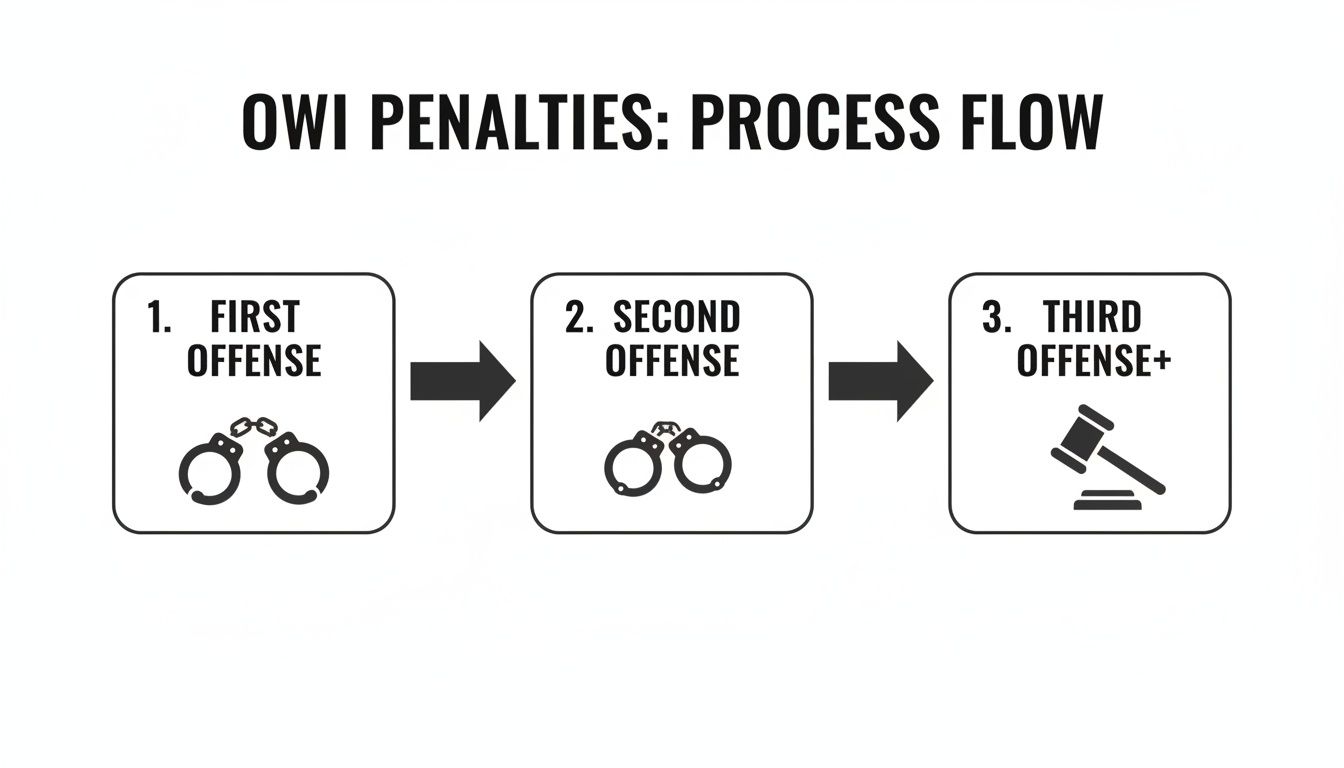
As you can see, the consequences—and the steps to get your license back—become far more demanding with each conviction.
The Reinstatement Process After A Suspension
If you’re facing a suspension from a first-time OWI, your path to getting back on your bike is the most straightforward of the bunch. Think of it like a checklist you have to complete.
Once your suspension period is over, you’ll need to pay off any outstanding court fines and a $125 reinstatement fee to the Secretary of State. Simple enough.
But there’s another critical piece to this puzzle: SR-22 insurance. This isn’t an actual insurance policy. It’s a certificate that your insurance company files directly with the state to prove you’re covered.
An SR-22 certificate essentially tells the state, “This person has the minimum required liability insurance.” It’s Michigan’s way of keeping a closer eye on you, and you’ll typically need to keep it active for three years.
Once your fees are paid and your SR-22 is on file, the state will reinstate your license, and your motorcycle endorsement comes right back with it. The whole thing is administrative, meaning no formal hearing is required.
Winning Your License Back After A Revocation
A revocation is a completely different ballgame. Your license isn’t just on pause; it’s gone. To get it back, you have to petition the Driver Assessment and Appeal Division (DAAD) for a hearing, and the burden of proof is 100% on you to show that you’re no longer a risk to public safety.
The process starts when you submit a formal request for a hearing. This isn’t just a simple form—you have to include several crucial documents:
- Substance Use Evaluation: Must be done by a qualified professional within the last three months.
- Letters of Support: You’ll need three to six notarized letters from people in your community who can speak to your sobriety and good character.
- Proof of Sobriety: This could be logs from AA/NA meetings, clean drug and alcohol test results, or any other hard evidence that you’ve stayed sober.
At the hearing itself, an officer will grill you about your past drinking/drug use, your current lifestyle, and what you’ve done to change. This is not a rubber-stamp approval. You have to make a convincing, honest case. For a deeper dive, our firm has created a comprehensive guide on Michigan driver’s license reinstatement after a DUI that breaks this all down.
Life With A Restricted License And BAIID
Even if the DAAD approves your request, you don’t just get your old license back. Instead, you’ll be on a restricted license for at least one year and required to install a Breath Alcohol Ignition Interlock Device (BAIID) in your vehicle.
The BAIID is a small breathalyzer hardwired into your car’s ignition system. To start the car, you have to blow into it and provide an alcohol-free breath sample. It also requires you to perform “rolling retests” while you’re driving to prove you’re still sober.
There are a few non-negotiable facts about the BAIID:
- No Motorcycles: A BAIID can’t be installed on a motorcycle. This means your restricted license is for a car only. You absolutely cannot ride your bike during this period.
- Strict Compliance: Any failed test, missed test, or attempt to tamper with the device gets reported straight to the Secretary of State. One screw-up can get your license re-revoked, sending you back to square one.
- Financial Cost: You pay for everything. The installation, the monthly monitoring fees, and the eventual removal all come out of your own pocket.
After you successfully manage at least one full year with the BAIID and have zero violations, you can finally petition the state to have the device removed. If approved, you’ll get your full, unrestricted driving privileges back—including your long-awaited motorcycle endorsement.
How a Skilled OWI Attorney Protects Your Riding Privileges
Trying to navigate an OWI charge on your own is a huge gamble, especially when your freedom to ride is on the line. It’s not just a court date; you’re fighting a two-front war against both the criminal charges and the Secretary of State’s administrative sanctions. Without an expert guide, it’s far too easy to make a mistake that could cost you your motorcycle endorsement for years.
A good OWI defense attorney doesn’t just read the police report and hope for the best. They take it apart, piece by piece, looking for every weakness in the prosecution’s case. This isn’t just about avoiding jail time—it’s about protecting your license so you can get back on the road.

Challenging the Arrest and Chemical Tests
A strong defense starts the moment the police lights flash in your rearview mirror. Your attorney will dig into the details. Did the officer have a legitimate reason to pull you over in the first place? Were the field sobriety tests administered correctly? The initial stop is often full of procedural errors that can get a case thrown out before it even really begins.
Next, we look at the chemical tests—the breath or blood results that the prosecutor will lean on heavily. An experienced lawyer knows exactly what to look for:
- Breathalyzer Records: Was the machine properly calibrated and maintained? A history of faulty readings can render the evidence useless.
- Testing Protocol: The officer administering the test needs to follow a strict, state-mandated procedure. Any deviation can call the results into question.
- Chain of Custody: For a blood draw, we trace the sample’s journey from your arm to the lab. Any gap or mistake in this chain can be grounds for suppression.
Finding just one of these errors can be enough to get the evidence tossed out. And without that evidence, the prosecution’s case often crumbles.
Negotiating for Reduced Charges
Not every case is won at trial. Sometimes, the smartest move is a strategic negotiation. An attorney who knows the local prosecutors and judges can often work out a deal to reduce the charge.
For example, getting an OWI reduced to a lesser charge like Operating While Visibly Impaired (OWVI) can make a world of difference for your license. The penalties are far less severe, meaning shorter suspensions and a much clearer path to getting your endorsement back.
This kind of result can be the difference between a few months of inconvenience and a multi-year ordeal.
Guiding You Through SOS Hearings
If your license does get revoked, the fight isn’t over. To get it back, you have to go through a hearing with the Secretary of State’s Driver Assessment and Appeal Division (DAAD). This isn’t a courtroom; it’s an administrative hearing where you have to prove, with clear and convincing evidence, that you are sober and will remain so.
An attorney’s role here is crucial. They act as your coach, helping you gather the right evidence—like substance abuse evaluations, proof of counseling, and letters of support—and preparing you for the intense questioning from the hearing officer. Going in unprepared is a recipe for denial.
As you think about getting legal help, it’s natural to wonder about how much a lawyer consultation fee might cost. Understanding the potential investment is the first step toward making a smart decision for your future. We also go into more detail on this topic in our article exploring if you need a lawyer for a DUI in Michigan. From the moment of arrest to the final hearing, a dedicated OWI lawyer is your strongest ally in getting back on your bike.
Your Top Questions About OWI and Your Motorcycle License Answered
If you’ve been arrested for an OWI, you’re probably wrestling with a ton of questions. It’s a confusing and stressful time, and a lot of misinformation floats around. Let’s cut through the noise and get you some straight answers about what this means for your Michigan motorcycle endorsement.
If My Driver’s License Is Revoked, Is My Motorcycle Endorsement Gone Too?
Yes, without a doubt. In Michigan, your motorcycle endorsement (that “CY” on your license) isn’t a separate document. It’s directly attached to your main driver’s license, so whatever happens to one, happens to the other.
Think of it this way: your driver’s license is the main account, and your CY endorsement is a special privilege linked to it. When the Secretary of State revokes the account for an OWI, all associated privileges are revoked right along with it. You’re legally barred from operating any vehicle on public roads, motorcycles included.
Getting back on your bike means first getting your driver’s license reinstated. Only after you’ve successfully navigated that entire process can you get your motorcycle endorsement restored.
Can I Get A Restricted License To Ride My Motorcycle To Work?
This is a question I hear all the time, but the answer is almost always a hard no. After a first OWI, you might be eligible for a restricted license to drive a car to essential places like work or school. But those privileges are very specific and don’t extend to two wheels.
Motorcycles are basically always excluded from restricted licenses for a couple of big reasons:
- Perceived Risk: The state sees motorcycles as inherently more dangerous than cars. Allowing someone with a recent OWI to ride one, even for work, is a risk they are simply unwilling to take.
- Ignition Interlock Devices: A Breath Alcohol Ignition Interlock Device (BAIID) is a standard requirement for getting restricted driving privileges. These devices can’t be installed on motorcycles, making it impossible to comply with the court’s order while riding.
So, while you might be able to get behind the wheel of a car, your bike will have to stay in the garage until your license is fully reinstated.
What If I Get A DUI In Another State? How Does That Affect My Michigan Motorcycle License?
Don’t assume an out-of-state DUI will stay out of state. Michigan is part of the Driver License Compact, which is an agreement between most states to share information about traffic violations and convictions.
When you get a drunk driving conviction in another state, they will report it directly to the Michigan Secretary of State. Once Michigan gets that notice, they treat it just as if the offense happened here. You’ll face the exact same penalties—suspension or revocation—as you would for a local OWI. That absolutely includes the loss of your motorcycle endorsement.
The bottom line is that state borders won’t protect you. An OWI in Florida or a DUI in Ohio will follow you home to Michigan and carry the same heavy consequences for your license and your freedom to ride.
To get your privileges back, you’ll have to go through Michigan’s reinstatement process, which could even mean a formal hearing with the Secretary of State, no matter where the conviction occurred.
What Happens If I Ride My Motorcycle With A Suspended License Anyway?
Riding with a suspended or revoked license is one of the worst mistakes you can make. This isn’t just another ticket; it’s a whole new criminal charge in Michigan called Driving While License Suspended (DWLS), and it’s a serious misdemeanor.
If you’re caught and convicted of DWLS, you’re looking at a fresh pile of penalties stacked right on top of your OWI sanctions. This can include:
- Steep Fines: Adding a significant financial burden to an already expensive situation.
- Potential Jail Time: Depending on your record, you could end up serving time.
- More Suspension Time: The court will hit you with another license suspension. And the worst part? It runs consecutively. That means it doesn’t even start until your original OWI suspension is completely over.
You’re essentially digging yourself a much deeper hole. A one-year revocation can easily turn into two or more years off the road. It’s a gamble that just isn’t worth the risk.
Trying to figure out the aftermath of an OWI on your own is tough, especially when your freedom to ride is at stake. You don’t have to face it alone. At David G. Moore, Attorney at Law, we know how to defend your rights and guide you through this complex process. For a strategic defense aimed at protecting your license and getting you back on the road, contact us today for a consultation.


