

When you’re facing a criminal charge, one of the first questions that comes to mind is, “How long is this going to take?” For a bench trial, the answer is refreshingly direct: a simple misdemeanor case might be over in just a few hours, while a more complicated felony could take several days.
The biggest reason for this speed? No jury. Taking a jury out of the equation completely changes the pace of a trial, streamlining everything from start to finish.
Why Bench Trials Are So Much Faster Than Jury Trials
To understand how long a bench trial takes, it’s more helpful to look at what doesn’t happen. A jury trial is loaded with extra steps designed to help a group of laypeople understand complex legal issues. A bench trial cuts all of that out.
Think of it this way: a jury trial is like a formal stage play. You have to select the audience (the jury), give them a program with all the background info (jury instructions), and present every piece of evidence in a way that’s simple enough for anyone to grasp. A bench trial is more like a direct, candid conversation with the director—the judge. They already know the script.
No Jury, No Delays
The single biggest time-saver is eliminating everything related to the jury. The court gets to skip several long and tedious procedures:
- Jury Selection (Voir Dire): This process alone can eat up hours, sometimes even a full day, as lawyers from both sides question potential jurors to find an impartial group.
- Jury Instructions: The judge doesn’t need to spend precious court time explaining complicated legal standards and rules to a dozen people who have no legal training.
- Jury Deliberation: There’s no waiting around for a jury to debate behind closed doors and come to a unanimous decision. A judge can often deliver a verdict much faster, sometimes right after the closing arguments wrap up.
Bench Trial vs Jury Trial At a Glance
The differences in timing and complexity between these two trial types are stark. Here’s a quick side-by-side comparison to put it all in perspective.
| Feature | Bench Trial (Judge Only) | Jury Trial |
|---|---|---|
| Decision-Maker | A single judge | A panel of citizens (usually 6 or 12) |
| Typical Duration | Hours to a few days | Several days to weeks |
| Complexity | Lower; focused on legal arguments for an expert | Higher; requires simplifying concepts and more procedural steps |
| Key Time-Savers | No jury selection, no jury instructions, no deliberation | N/A |
| Verdict Speed | Often immediate or within a few days | Can take hours or days of deliberation |
This table makes it clear why a bench trial is almost always the faster route. When the judge is the one making the decision, the entire process is built for efficiency.
This isn’t just a feeling; the numbers back it up. A study from the Federal Judicial Center found that bench trials were dramatically shorter than jury trials. On average, federal bench trials took up just 6.9 trial days per month, while jury trials required 13.5 days—making bench trials over 50% faster.
In a bench trial, the arguments are presented directly to a legal expert. This lets attorneys cut straight to the core legal issues instead of spending time on the simplified, and often longer, explanations a jury needs.
This streamlined approach is a major reason why some defendants in Michigan choose a bench trial. The process gets straight to the point without the procedural hurdles of a jury trial. It’s also a very different experience from earlier court dates, which you can read about in our guide on how long a preliminary hearing takes. By stripping away the layers needed for a jury, the court can move from opening statements to a final verdict in a fraction of the time.
The Key Factors That Shape Your Trial Timeline
Ever wonder why one person’s bench trial is over in an afternoon, while another seems to drag on for days? It’s not random. Predicting how long a trial will take is less like checking a bus schedule and more like a weather forecast—you have to look at all the different elements coming together to get a realistic idea.
Understanding these factors is crucial for setting your own expectations. Your attorney will size up each one to give you an estimate, making sure you’re prepared for what’s ahead. Let’s break down the main things that control the clock in the courtroom.
The Complexity of Your Case
This is the big one. The single most important factor is how complicated your case is. Think of it like a story: a simple plot wraps up quickly, but a complex one with lots of twists and turns needs more time to be told properly.
-
Simple Cases: A straightforward misdemeanor, like a first-offense DUI where the evidence is a clear-cut breathalyzer result, might only have one or two legal issues to sort out. These are the “short stories” of the legal world, often resolved in just a few hours.
-
Complex Cases: On the other hand, a felony charge built around tangled financial records or conflicting expert opinions is more like a multi-chapter novel. These cases demand in-depth legal arguments and can easily stretch a bench trial across several days.
The Number of Witnesses
Every single person who takes the stand adds time. It’s not just their initial testimony (direct examination). It’s also the follow-up questioning from the other side (cross-examination), which can sometimes take even longer.
A case with just two or three witnesses—say, the defendant and the arresting officer—is going to move a lot faster than one with a dozen people slated to testify. And when expert witnesses like forensic scientists or doctors get involved, the timeline can expand significantly. Their specialized testimony often requires hours of detailed questioning to establish their credibility and pick apart their findings.
The flow of a trial can be completely altered by the sheer volume of testimony. Each witness adds a new layer for the judge to consider, from their initial story to how they hold up under a tough cross-examination.
The Volume of Evidence and Motions
The amount of physical and digital evidence the judge needs to review plays a huge role, too. A few key documents can be examined quickly. But a case that hinges on hundreds of pages of bank statements, hours of video footage, or complex digital forensics will naturally take up more court time.
On top of that, pre-trial motions can affect the schedule before the trial even starts. These are formal requests made to the judge, like a motion to throw out evidence that was collected illegally. Just arguing and deciding on these motions can sometimes eat up a big chunk of the court’s time before the first witness is even called. Each piece of evidence and every motion is another piece of the puzzle the judge has to fit into place, directly shaping your trial timeline.
A Step-By-Step Walkthrough of the Bench Trial Process
To really wrap your head around how long a bench trial takes, it helps to stop thinking of it as a single event. It’s actually a series of structured, predictable steps. Once you know the roadmap, the journey feels a lot less intimidating.
This guide breaks down the whole process, from the final prep work before you even see the courtroom to the moment the judge makes a final decision. Knowing what’s coming at each turn helps you understand what’s happening as your attorney argues your case.
Before the Trial Day
The real work starts long before you walk into the courthouse. The days and weeks leading up to the trial are all about setting the stage for success.
-
Final Pre-Trial Conference: This is usually the last huddle before game day. Your lawyer and the prosecutor meet with the judge to confirm everyone is ready, iron out any last-minute scheduling wrinkles, and agree on how the trial will run. It’s the final systems check.
-
Witness and Evidence Preparation: Your attorney will be spending a ton of time getting witnesses ready for their testimony. This means running through potential questions, coaching them on how to answer honestly and clearly under pressure, and organizing every piece of physical evidence—like documents, texts, or photos—so it can be presented smoothly in court.
The Flow of the Trial Itself
When the trial day arrives, things unfold in a very specific order. While the time spent on each step can change, the sequence is always the same.
To help you visualize how a typical bench trial day unfolds, here’s a quick summary of the key events in the order they happen.
Typical Bench Trial Day Flow
| Event Order | What Happens | Purpose |
|---|---|---|
| 1. Opening Statements | Each side gives a short speech. The prosecutor goes first, laying out their theory of the case. Then, your attorney presents your side, giving the judge a roadmap of why you’re not guilty. | To give the judge a preview of the evidence and arguments they are about to hear. |
| 2. Prosecution’s Case-in-Chief | The prosecutor calls their witnesses and introduces their evidence (exhibits). Your attorney gets to cross-examine each of their witnesses. | The prosecutor’s attempt to prove guilt beyond a reasonable doubt. Cross-examination is meant to poke holes in their story. |
| 3. Defense’s Case-in-Chief | Now it’s your turn. Your attorney presents evidence and may call witnesses to counter the prosecutor’s claims. You might testify, but that’s a strategic call you’ll make with your lawyer. | To create reasonable doubt by presenting your side of the story or challenging the prosecution’s evidence directly. |
| 4. Closing Arguments | Both lawyers give one final speech. They summarize the evidence they presented and argue why the judge should rule in their favor. | To connect all the dots for the judge and make a final, persuasive argument for acquittal or conviction. |
| 5. The Verdict | The judge delivers their decision—guilty or not guilty. | To officially resolve the case at the trial level. |
This table gives you the basic structure, but let’s dive a little deeper into what each stage feels like.
1. Opening Statements
Think of this as the trailer for the movie. The prosecutor goes first, telling the judge what they plan to prove. Then your defense lawyer gets up and gives the judge a preview of the evidence that will establish your innocence or show the state can’t meet its burden of proof.
2. Prosecution’s Case-in-Chief
This is where the state puts on its show. They’ll call their witnesses to the stand for direct examination and introduce documents or photos as exhibits. After each witness testifies, your attorney gets to grill them in a process called cross-examination. This is our chance to challenge their memory, expose inconsistencies, and weaken the prosecutor’s case.
3. Defense’s Case-in-Chief
Now, the ball is in our court. Your attorney will present your defense. This could mean calling your own witnesses to the stand or introducing evidence that tells your side of the story. Whether you testify yourself is a huge strategic decision you and your lawyer will have made long before this moment. And just like their witnesses, any witness we call can be cross-examined by the prosecutor.
The infographic below shows the key factors that can stretch out each of these phases.
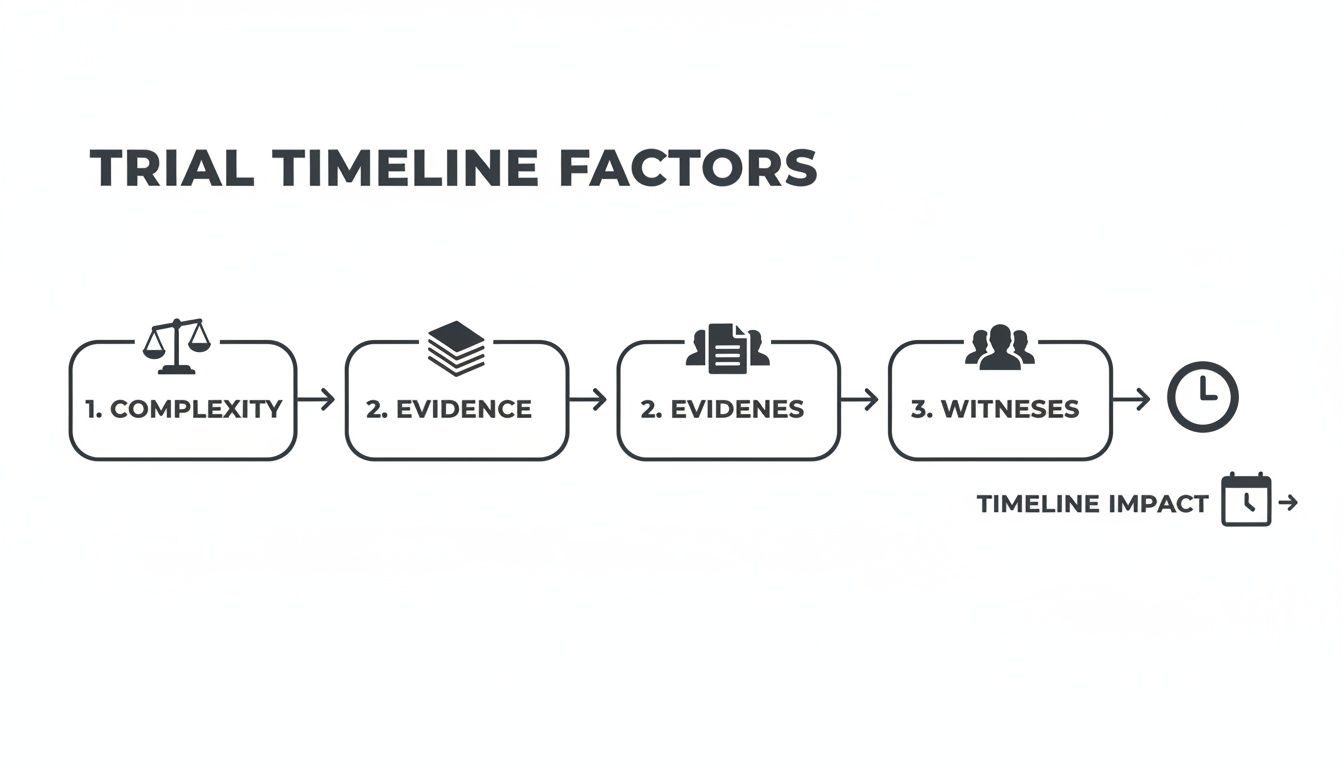
As you can see, a case with complex legal arguments, mountains of documents, or a long list of witnesses is naturally going to take more time.
4. Closing Arguments
After all the testimony and evidence is in, both sides get one last shot to convince the judge. They’ll summarize the strongest points of their case, highlight the key evidence, and explain why the law demands a ruling in their favor.
A closing argument isn’t about bringing up new facts. It’s about weaving all the testimony and evidence you’ve already heard into a story that leads the judge to one logical conclusion: yours.
The Verdict
This is the final step. In a bench trial, there’s no jury disappearing into a back room for hours or days. The judge has heard it all.
In many straightforward cases, especially misdemeanors, the judge is often ready to deliver a verdict right after the closing arguments. For more complicated cases, the judge might take a short recess to review their notes or even schedule a new date to come back and announce the decision. Once the verdict is read, the trial itself is officially over.
Bench Trial Timelines for Misdemeanors vs. Felonies
Theory is great, but what does this look like in the real world? The biggest factor impacting how long a bench trial takes is simple: are you facing a misdemeanor or a felony?
That single question can mean the difference between being in court for a few hours versus a few days. Let’s walk through two common scenarios we see in Southwest Michigan courts to show you what I mean.
The Misdemeanor OWI Case: A Single-Day Affair
Picture a first-offense OWI/DUI charge in Kalamazoo or St. Joseph County. This is a perfect example of a case that’s often resolved quickly in a bench trial because the scope is incredibly narrow.
- Limited Witnesses: The prosecutor usually just calls one or two people to the stand—typically the officer who pulled you over and maybe the one who ran the breathalyzer test.
- Focused Evidence: The evidence is tight and predictable: police reports, dashcam footage, and the chemical test results. The arguments are just as focused, centering on things like whether the traffic stop was legal or if the DataMaster was calibrated correctly.
- Clear Legal Questions: At the end of the day, the judge is there to answer a handful of direct questions. Was the stop lawful? Was there probable cause to arrest? Were the tests done by the book?
Because the entire story is self-contained and the legal issues are so precise, a standard OWI bench trial is often wrapped up in a single afternoon. We’re talking a few hours from opening statements to the final verdict.
The Felony Drug Distribution Case: A Multi-Day Proceeding
Now, let’s flip the script to a much more serious felony charge, like possession with intent to distribute narcotics. This is a completely different ballgame. Even without a jury, the trial will take much longer.
Why? Because the prosecutor has a much higher mountain to climb to prove guilt beyond a reasonable doubt.
For a felony, the legal arguments are more intricate and the evidence is often layered. The judge needs more time to hear from experts, review detailed evidence, and consider complex legal challenges from the defense.
Here’s a breakdown of why a felony case stretches out:
- Multiple Witnesses: The prosecution isn’t just calling one officer. They might bring in undercover officers, confidential informants, the team that executed a search warrant, and crime lab technicians.
- Expert Testimony: A forensic chemist will almost certainly testify about the type and weight of the drugs. That testimony alone, plus the cross-examination from your attorney, can eat up a huge chunk of time.
- Complex Evidence: We’re not just looking at a police report. The evidence could include months of text messages, surveillance video, financial records, and every report filed during the investigation. Each item has to be introduced, explained, and argued over.
- Legal Motions: Felony cases are famous for legal battles over evidence. Your attorney will likely file motions to suppress evidence from a questionable search, which adds another layer of argument for the judge to consider.
With all these moving parts, a felony bench trial can easily last for two to three days, or even longer. Every witness, every piece of evidence, and every legal motion adds another chapter to the story the judge has to hear before making a decision.
How You and Your Attorney Can Prepare for Trial

While your attorney is the one leading the charge, don’t underestimate your own role in your defense. Your active participation is an incredibly powerful tool. Think of yourself as a vital member of the legal team, because that’s exactly what you are.
Taking a proactive approach can genuinely strengthen your case, give your attorney the ammunition they need to fight effectively, and restore a sense of control during a deeply stressful time. This collaboration is about much more than just showing up to court. It’s about organization, total honesty, and a commitment to being the most prepared client—and witness—you can be.
Gather and Organize Every Single Document
Your attorney needs access to every piece of paper, every email, every text message even remotely related to your case. My advice? Don’t hold anything back or try to guess what’s important. Let your lawyer decide that.
Gather all the documents you can find and arrange them in chronological order. This one step can save your legal team hours of work and often shakes loose critical details you might have completely forgotten.
This includes things like:
- Police reports and any citations you received
- All correspondence from the court or the prosecutor’s office
- Photos or videos from the incident, no matter how minor they seem
- Contact information for anyone who might have seen or heard something
Being organized makes you a much more effective partner in your own defense. For a deeper dive into what a successful strategy looks like, you can learn more about how to win a bench trial in our detailed guide.
Be Completely Open and Honest
Your attorney can only build a defense based on the information they have. Holding back embarrassing or seemingly damaging details is one of the single biggest mistakes a client can make. It almost always backfires.
Your conversations with your attorney are protected by attorney-client privilege. This is a legal shield that allows you to be completely transparent without any fear that your words will be used against you in court.
Surprises are great for birthdays but absolutely terrible for a trial. Tell your lawyer everything—the good, the bad, and the ugly. This allows them to anticipate the prosecutor’s arguments and build a strategy that accounts for all the facts, not just the convenient ones.
Prepare for Your Testimony
Even if there’s a good chance you won’t take the stand, you absolutely must prepare as if you will. Testifying is a skill, and like any skill, it requires practice to do it well.
Your attorney will work with you to go over potential questions from both the prosecutor and from our own side. This isn’t about memorizing a script. It’s about learning how to tell your side of the story clearly, calmly, and truthfully, especially under the pressure of cross-examination. This prep work ensures that if you do testify, you’ll come across as a credible and effective witness for your own defense.
What Happens After the Judge’s Verdict
The moment the judge says “guilty” or “not guilty,” the trial itself is over, but your legal journey is far from finished. That verdict is a massive fork in the road, and what comes next depends entirely on which direction the judge points you.
A verdict of not guilty is an incredible wave of relief. It means the prosecutor just couldn’t prove their case beyond a reasonable doubt. The judge will officially dismiss the charges, and you are free to walk out of the courtroom with your record clean, as if the whole thing never happened.
Navigating a Guilty Verdict
If the verdict is guilty, the case shifts into its next critical phase: sentencing. This isn’t something that happens on the spot. The court will set a separate date for a sentencing hearing, often weeks or even months down the road, especially in felony cases.
That gap isn’t just dead time; it’s when several key steps take place:
- Pre-Sentence Investigation (PSI): A probation officer is assigned to dig into your background. They look at your criminal history, job, family life—everything—and compile it all into a formal report for the judge.
- Sentencing Memorandums: This is where your attorney and the prosecutor each file documents arguing for what they see as a fair sentence. They’ll use the law and the details from that PSI report to make their case.
When the sentencing day arrives, both lawyers will make their final arguments to the judge, and you’ll get a chance to speak for yourself. After hearing from everyone, the judge will hand down the sentence, which could be anything from fines and probation to time in jail or prison.
A guilty verdict is a tough, disheartening blow, but it’s crucial to understand it doesn’t have to be the end of the line. The fight can, and often does, continue on a new front.
This is where an appeal comes into play. An appeal isn’t a do-over trial. It’s a formal request for a higher court to look for legal mistakes that might have happened during your trial. This is why understanding the importance of the trial record for a Michigan criminal appeal is so critical, because that transcript is the entire foundation for challenging the verdict.
Frequently Asked Questions About Michigan Bench Trials
Going through the court system brings up a ton of questions. It’s completely normal to feel uncertain. This section gives you straight, simple answers to the most common things clients worry about when it comes to bench trials.
Can I Change My Mind About Having a Bench Trial?
Yes, but there’s a point of no return. You have the right to give up a jury trial and choose a bench trial instead. But once you officially state that choice in court—on the record—it’s extremely difficult to take it back. Sometimes, it’s impossible.
This is a major strategic decision that you and your attorney need to lock in long before the trial date is on the calendar. Courts need finality to keep cases moving, and judges are not fans of last-minute changes that cause delays.
Does a Faster Trial Mean a Rushed Verdict?
Not at all. A bench trial is faster because it’s more efficient, not because it’s rushed. A judge is a legal expert who has seen hundreds, if not thousands, of cases just like yours. They can get through evidence and legal arguments much more quickly than a jury of laypeople.
A judge doesn’t need basic legal concepts explained to them, which cuts out hours of instructional time. The focus is on the core facts and legal disputes, allowing for a swift but thorough consideration of your case.
This streamlined approach lets the judge zero in on what really matters in your case. The result is a verdict based on a careful legal analysis, not a snap judgment.
Will the Judge Announce the Verdict Immediately?
It really depends on how complicated the case is. For a straightforward misdemeanor, like a basic DUI, it’s very common for the judge to deliver the verdict right after the lawyers finish their closing arguments. They’ve heard everything they need to make a decision.
But for more complex felony trials with a mountain of evidence or tricky legal issues, a judge might take the case “under advisement.” This just means they need time to think it over—it could be a few hours or even a few days. They’ll review their notes, the evidence, and the law before calling everyone back to court to announce their decision.


