

Choosing a bench trial is a high-stakes strategic call. Your success boils down to a single question: is your case better suited for a judge’s legal analysis or a jury’s gut reaction? Getting this right is the first, and most important, step in deciding whether waiving a jury is your best path to winning.
This isn’t a decision you make lightly. It requires a hard look at the evidence, the specific charges you’re facing, and the unique dynamics of your case.
Is a Bench Trial Your Winning Move?
The constitutional right to a trial by a jury of your peers is a bedrock of our justice system. But here’s what many people don’t realize: it’s not always your best shot.
Waiving that right for a bench trial—where a judge alone decides your fate—can be a game-changing move. It can dramatically shift the odds in your favor, but only if the circumstances are right.
The heart of the matter is knowing your audience. A jury is made up of everyday people who can be swayed by powerful stories, personal biases, and emotional appeals. A judge, on the other hand, is a legal expert. They are trained to cut through the noise, apply the law to the facts, and lean on statutes and precedent, not feelings.
This flowchart gives you a starting point for thinking through that core difference.
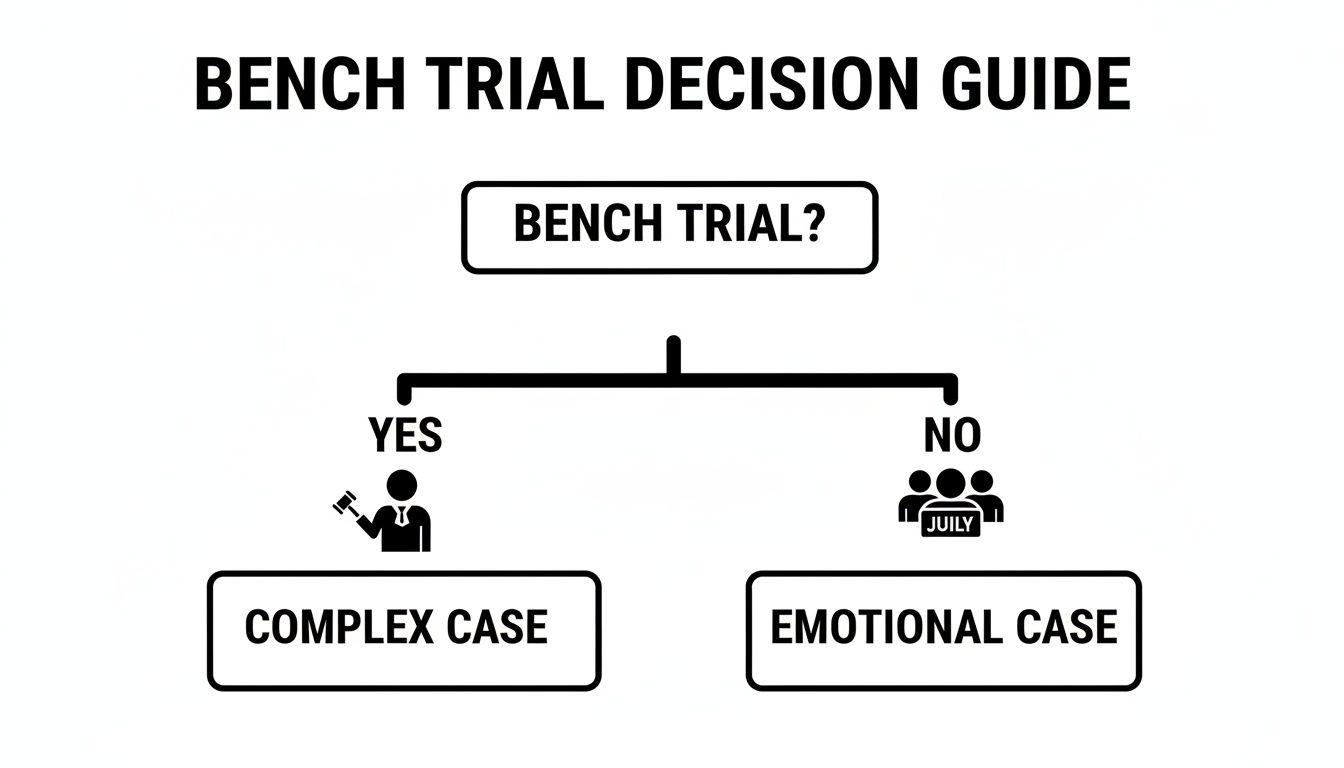
The takeaway is simple but powerful: complex or technical defenses belong in front of a judge. Cases built on sympathy or human connection often play better with a jury.
When a Judge-Only Trial Is the Smarter Choice
Some cases are just tailor-made for a bench trial. If your entire defense rests on a subtle interpretation of a Michigan law or a complicated technical argument, a judge is far more likely to get it than twelve people who might just tune out.
Think about these situations where a bench trial gives you a clear edge:
- Legally Complex Cases: Maybe your defense involves challenging a bad search warrant or arguing that key evidence shouldn’t be allowed. These are arguments rooted in case law and constitutional law that a judge lives and breathes.
- Technically Dense Evidence: Is your case full of digital forensics, confusing financial records, or dry scientific testimony? A jury might get lost, bored, or just plain confused. A judge knows how to sift through that kind of evidence logically.
- Emotionally Charged or Unpopular Cases: If the facts of your case are ugly, or if you’re not going to be a sympathetic figure on the stand, a jury could easily be biased against you from the start. A judge is trained to stay impartial and focus only on what the law and evidence say.
The most critical question you and your attorney need to answer is this: “Will my defense make more sense to a legal expert or to a panel of regular people?” Your entire trial strategy flows from that answer.
The Statistical Edge You Can’t Ignore
Beyond strategy, the numbers themselves often make a compelling case for a bench trial. Data, particularly from the federal system, shows a striking difference in acquittal rates. Before 1989, conviction rates were almost the same for both. But after federal sentencing guidelines were introduced, a huge gap opened up.
Federal judges now convict at a 55% rate, which gives a defendant a 45% chance of being acquitted. Juries? They convict at an 84% rate, leaving just a 16% chance of acquittal. That’s a massive 29% swing in a defendant’s favor just by choosing a judge.
Now, before you make a final decision, it’s essential to compare how these factors apply directly to your case. This table breaks down the strategic considerations to help you weigh your options.
Bench Trial vs Jury Trial Strategic Considerations
| Factor | Bench Trial (Judge) | Jury Trial (Jury) |
|---|---|---|
| Decision-Maker | A single, legally trained judge. | A panel of 12 laypeople (6 in some MI cases). |
| Focus | Strict application of law to facts. | Emotional narratives, credibility, and “fairness.” |
| Best For… | Technically complex or legally nuanced defenses. | Cases with sympathetic facts or an emotional appeal. |
| Evidence Rules | Rules of evidence applied precisely and consistently. | More susceptible to prejudicial or emotional evidence. |
| Speed & Efficiency | Generally faster and more streamlined. | Slower, with lengthy jury selection and instructions. |
| Predictability | More predictable outcome based on precedent. | Less predictable; can be swayed by non-legal factors. |
| Risk Factor | Unfavorable facts that inflame passion or prejudice. | Defenses that are too complex for a jury to follow. |
This table provides a framework, but the final choice is deeply personal and depends entirely on the specifics of your situation.
While these are federal stats, they point to a crucial truth: judges are often more willing to acquit when the prosecution simply fails to meet its burden of proof beyond a reasonable doubt. They see it as a legal standard, not an emotional one. This is a powerful insight.
Ultimately, evaluating the pros and cons requires a deep dive into the specifics of your case. That’s why having a candid, strategic conversation with your attorney is so critical. You can learn more about making the most of these discussions in our guide on the role of legal consultation in criminal defense.
Building an Airtight Case Before the Trial Begins
A winning bench trial isn’t something you pull together in the courtroom; it’s built meticulously, piece by piece, long before you ever see the judge. Think of the pretrial phase as the real battleground. This is where sharp, aggressive preparation can dismantle the prosecution’s case and set the stage for a not-guilty verdict.
This period is all about proactive strategy. It means digging for every scrap of evidence, challenging the government’s methods at every turn, and building the core narrative that will guide the judge’s view of the facts. Get this part right, and the trial itself often becomes a formality—a confirmation of the work you’ve already done.
Leveraging Pretrial Motions Before a Judge
Pretrial motions are your first, and often most powerful, offensive weapon. While they’re a standard part of any criminal case, their impact gets amplified in a bench trial. A judge, unlike a jury, has a deep understanding of the legal nuances behind these motions and won’t hesitate to grant them if the law is on your side.
A Motion to Suppress Evidence is a perfect example. If the police conducted an illegal search or coerced a confession, a successful motion gets that evidence thrown out completely. For a judge, this is a clean, legal decision based on precedent. For a jury, the damage is often done—you can’t un-ring that bell, even with an instruction to disregard what they heard. Getting key evidence tossed before a bench trial can gut the prosecution’s entire case before it even starts.
A well-argued pretrial motion does more than just exclude evidence. It signals to the judge that you have a command of the law and are prepared to challenge the prosecution on every technical and procedural point.
The Power of Proactive Discovery
The discovery process is far more than a simple exchange of paperwork. It’s your chance to play detective. The goal is to request and scrutinize every single piece of the prosecution’s evidence—police reports, witness statements, lab results, and every second of body-cam footage.
This is where you hunt for the gaps and contradictions.
- Do the witness statements tell different stories?
- Does the officer’s body-cam footage actually match their written report?
- Are there chain-of-custody problems with the physical evidence?
Each inconsistency is a thread you can pull to unravel the prosecution’s narrative. This is also the time to gather your own evidence, whether that’s finding defense witnesses the police overlooked or getting records that tell your side of the story. It’s crucial to understand what you’re looking at; you can learn more about the four types of evidence in Michigan criminal trials to sharpen your strategy.
Crafting Your Central Case Theory
Every move you make—every motion filed, every document requested—must serve a single, unified purpose: advancing your case theory. This is the core story of your defense. It’s a simple, logical explanation of the facts that leads to only one conclusion: your innocence or, just as importantly, the prosecution’s failure to meet its burden of proof.
Your case theory is the spine of your entire defense. It tells you which witnesses to call, what questions to ask, and which pieces of evidence to highlight for the judge.
A strong case theory must be:
- Grounded in Law and Fact: It has to align with the undisputed evidence and be supported by Michigan law.
- Simple and Clear: A judge should be able to grasp it in a few sentences. No convoluted explanations.
- Comprehensive: It needs to account for all the major facts, especially the ones that seem to work against you.
For instance, in a drug possession case, your theory might not be “I never saw it before.” A stronger theory might be, “The prosecution cannot prove beyond a reasonable doubt that I had knowledge and control of the substance, as the law requires.” This approach focuses the judge’s attention on a specific legal element the prosecution is struggling to establish.
To stay on top of the mountain of documents needed to build a solid case, many attorneys find that tools like legal dictation software can be a huge help. They make it easier to organize notes, draft motions, and manage discovery materials without getting bogged down.
By the time you walk into that courtroom, your case theory should be so well-established through your motions and discovery that your trial presentation feels like the logical, final chapter to a story the judge has already started to believe.
Mastering the Art of Judicial Persuasion
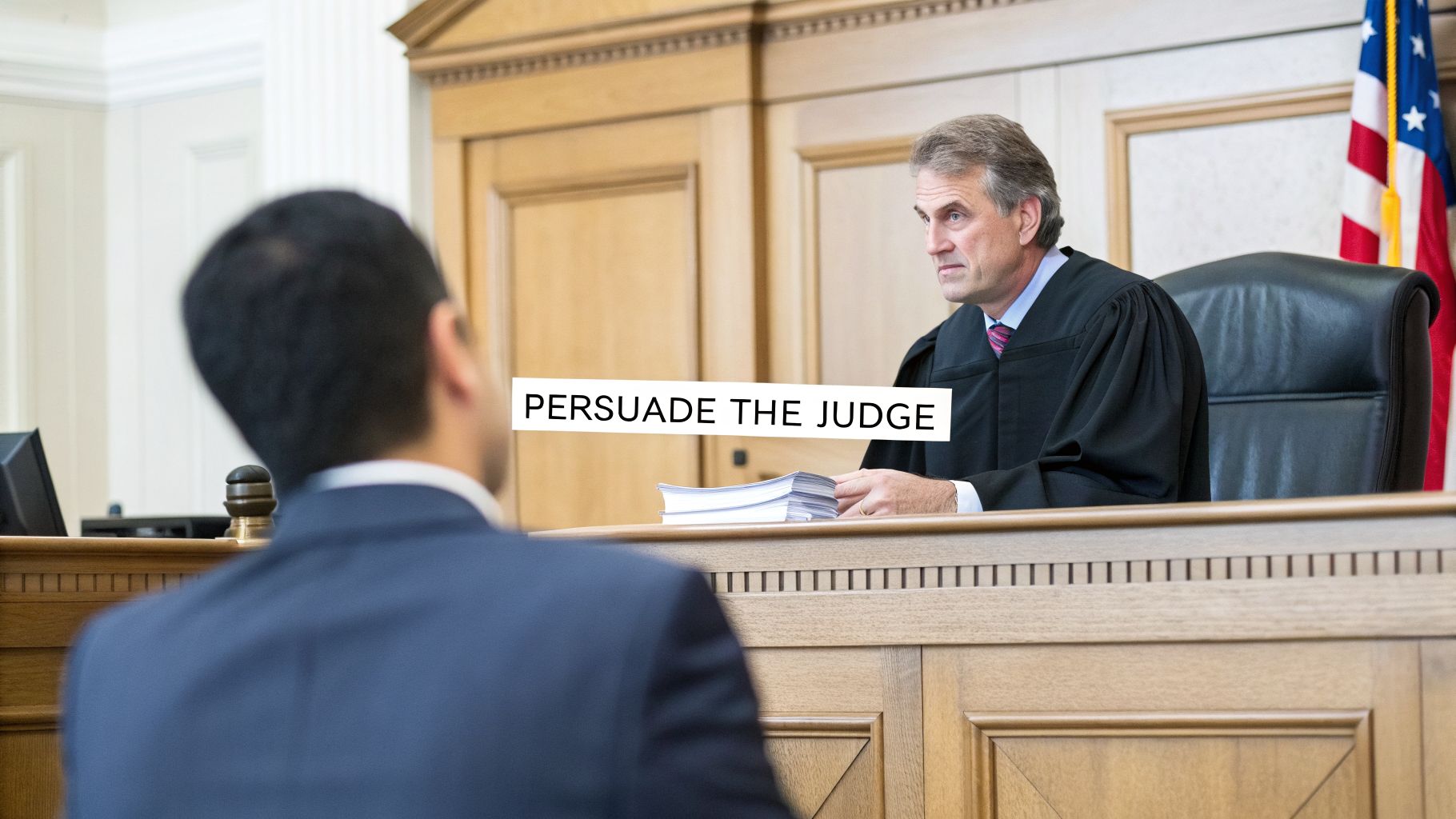
Let’s get one thing straight: persuading a judge is a completely different ballgame than winning over a jury. The dynamic shifts from emotional, narrative-driven storytelling to a clinical, logical argument. To win a bench trial, you have to shelve the dramatic flourishes and focus on one thing: presenting your case as a clear, organized legal analysis that leads to the only possible conclusion—acquittal.
A judge isn’t just a passive audience. They’re an active participant, a trained legal professional whose job is to poke holes in arguments and spot every weakness. Your mission is to make their job easy. You need to connect the dots for them, explicitly linking every single piece of evidence and testimony directly to the specific elements of the law.
Speak the Judge’s Language
A judge thinks in statutes, case law, and burdens of proof. Any emotional plea about fairness or your client’s good character, which might sway a jury, will fall flat here. Instead, every single argument you make must be firmly anchored in the law.
This means you frame your defense around the legal elements the prosecution is required to prove beyond a reasonable doubt. For example, don’t just argue that your client wasn’t there. Structure your argument like this: “Your Honor, the state has failed to prove the element of presence, a required element under MCL 750.82…” This direct, law-focused approach respects the judge’s expertise and keeps their focus exactly where it needs to be: on the legal standard.
Your courtroom demeanor is also non-negotiable. Maintain a respectful, professional tone, follow local court procedures to the letter, and demonstrate a complete command of the facts without a hint of exaggeration. This is how you build credibility, which is everything when one person holds the fate of your case in their hands.
A judge is looking for a clear path to a verdict. Your job is not to create sympathy but to provide a legally sound roadmap that leads them directly to a finding of “not guilty.”
Structuring Your Argument for Maximum Impact
The most effective presentation in a bench trial is methodical, systematic, and almost surgical. Every part of the trial, from opening to closing, has to build on the last, reinforcing your central case theory with absolute precision.
- Your Opening is a Roadmap: Forget the dramatic narrative you’d give a jury. Your opening statement should be a concise, logical outline of what the evidence will show and, more importantly, how that evidence proves the prosecution cannot meet its burden. Think of it as an executive summary for a busy legal professional.
- Present Evidence with Purpose: Introduce each piece of evidence in a clear, sequential order. For every exhibit, explain its relevance and how it fits squarely into your legal argument. The goal is clarity, not volume. Avoid overwhelming the judge with redundant or confusing material; every piece must have a distinct, important purpose.
- Keep Witness Testimony Tight: Direct examination should be incredibly focused. You’re not letting a story unfold; you’re establishing specific facts that support your legal theory. Don’t let your witnesses ramble. Your questions should guide them to provide the exact information the judge needs to hear.
This structured, almost rigid approach makes it much easier for the judge to follow your logic and, ultimately, adopt your points into their final analysis. It’s less about telling a story and more about building an airtight legal equation.
The Closing Argument: A Clinical Deconstruction
Your closing argument is your final chance to tie it all together into a neat, undeniable package. This is where you systematically deconstruct the prosecution’s case, element by element, and show the judge exactly where the state failed to meet its burden of proof beyond a reasonable doubt.
I highly recommend a checklist-style approach. Address each charge and its required legal elements one by one. For each element, summarize the evidence—or the glaring lack of it—and connect it right back to the law. This clinical method is far more persuasive to a judge than a passionate, sweeping appeal.
Understanding how judges process information is the key to unlocking this. While criminal and civil cases are different, data from civil litigation gives us a valuable window into their decision-making. Civil plaintiffs, for instance, won in 65% of bench trials but only 53% of jury trials. This trend holds across different case types and suggests that judges can be more systematic and predictable when applying facts to the law. That’s a trait you can use to your advantage. You can find more insights on this at Advocate Magazine.
By presenting a logical, law-based defense, you’re doing more than just arguing your case. You’re giving the judge the legal framework and justification they need to rule in your favor. This mastery of judicial persuasion is what separates a good argument from a winning one.
Preparing Witnesses for High-Stakes Testimony

In a bench trial, your witness testimony isn’t just part of the story—it often is the entire story. A judge is a seasoned expert at spotting hesitation, evaluating body language, and catching the kind of subtle inconsistencies a jury might miss.
This means witness prep has to go way beyond just reviewing the facts. It’s about building unshakeable credibility.
Every word, every pause, every shift in posture on the stand gets magnified and scrutinized. Unlike a jury trial where a compelling narrative can sometimes smooth over minor factual bumps, a judge is laser-focused on precision and consistency. Proper preparation is the only way to ensure your witnesses deliver a clear, truthful, and powerful account that locks in perfectly with your case theory.
The Foundation of Credible Testimony
The goal here is simple: make sure your witnesses can tell the truth, clearly and confidently. This isn’t about scripting answers or putting words in their mouths. It’s about empowering them to communicate what they know, even under the intense pressure of cross-examination.
Your attorney should be meeting with each witness multiple times. The first sessions are for drilling down on the facts and their specific role in the case. Later on, those sessions need to become full-blown simulations of the courtroom experience, complete with mock direct and cross-examinations. This repetition builds a kind of muscle memory, helping the witness stay calm and focused when it really counts.
Key areas to drill down on include:
- Simplifying the Complex: Can the witness explain technical or complicated events in plain, direct language? The judge needs testimony that’s easy to follow and slot into their findings of fact. No jargon, no confusion.
- Mastering the Facts: Witnesses must know their version of events inside and out, but without sounding like a robot. They have to be completely comfortable with timelines, key details, and any documents they might be shown.
- Understanding the Courtroom: We walk them through the whole process. Who’s who, where to look when speaking (at the attorney asking, then at the judge when answering), and how to properly address the judge (“Your Honor”).
The most credible witnesses aren’t the ones with flawless answers. They’re the ones who are clearly and consistently telling their truth. Preparation builds the confidence to do just that without getting rattled.
Handling Cross-Examination with Composure
Cross-examination is designed to do one thing: create doubt. The prosecutor will use leading questions, poke holes in memories, and try to get your witness defensive. Preparing them for this gauntlet is absolutely critical to winning a bench trial.
We teach witnesses a few core principles for surviving the hot seat:
- Listen. Carefully. Never, ever answer a question you don’t fully understand. It’s perfectly fine to say, “Can you rephrase that?” or “I don’t understand the question.”
- Pause Before Answering. Take a beat. A brief moment to process the question and form a concise answer prevents blurting something out or walking into a trap.
- Answer Only the Question Asked. Do not volunteer extra information. Short, direct answers—”Yes,” “No,” “I don’t recall”—are the best defense against a prosecutor trying to open up new lines of attack.
- Stay Calm and Respectful. Even if the prosecutor gets aggressive, the witness cannot become argumentative. A calm demeanor projects confidence and credibility straight to the judge.
The Defendant’s Dilemma: Should You Testify?
Now for the most crucial witness decision of all: whether the defendant takes the stand. This choice is loaded with risk and can single-handedly decide the outcome. The judge will be watching your every move, listening to every word, and sizing up your credibility with an intensely critical eye.
Deciding whether you should testify comes down to weighing several key factors:
- The Strength of the Prosecution’s Case: If the state’s evidence is thin, staying silent and letting your attorney hammer their case might be the smartest play. Why give them a shot at you?
- Your Ability to Remain Composed: Can you really handle an aggressive cross-examination without getting angry, defensive, or flustered? A poor performance can be devastating.
- The Existence of a Criminal Record: If you testify, the prosecutor may get the chance to bring up past convictions to attack your credibility. That can be incredibly damaging in a judge’s eyes.
This decision should only be made after extensive preparation and a brutally honest assessment with your attorney. You might also want to explore our article on the use of expert witnesses in criminal defense if your case involves complex evidence. Ultimately, well-prepared witnesses—and especially a well-prepared defendant—can deliver the credible, persuasive testimony you need to win.
Navigating Courtroom Procedure and Avoiding Critical Errors
Knowing your way around the courtroom isn’t just about looking the part; it’s about using the rules to your strategic advantage. In a bench trial, the judge is your entire audience. They’re the referee and the jury. A polished, professional presentation can genuinely influence how they see your case.
Every little slip-up, no matter how small, can chip away at the credibility you’ve worked so hard to build.
A deep command of trial mechanics—from the flow of an opening statement to the nuances of Michigan’s evidence rules—is non-negotiable. This isn’t just for show. Your ability to navigate procedure smoothly tells the judge you’re competent, prepared, and serious, which adds weight to the substance of your defense.
The Art of the Timely Objection
Knowing when to object is a critical trial skill. So is knowing how. A timely, well-articulated objection does more than just keep improper evidence out. It shows the judge you have a firm grasp of the law and, crucially, protects your client’s rights for a potential appeal down the road.
A judge will appreciate legally sound objections made confidently and without hesitation. Fumbling for the right words or, worse, making frivolous objections will only annoy the court and make you look unprepared. On the flip side, failing to object when you should means damaging testimony can slide right into the record, completely unchallenged.
An objection is a strategic tool. It’s not about disrupting the trial; it’s about controlling the narrative and ensuring the judge’s decision is based only on legally admissible evidence. A correctly executed objection shows the judge you’re paying close attention to every detail.
Objecting effectively requires knowing the rules of evidence inside and out. Here’s a quick rundown of some common objections you’ll encounter in a criminal trial and when they are most effective.
Common Objections in a Criminal Trial
A summary of common evidentiary objections and when to use them effectively during a bench trial.
| Objection Type | When to Use It | Example |
|---|---|---|
| Hearsay | When a witness repeats an out-of-court statement to prove the truth of the matter asserted. | “Objection, Your Honor. The witness is testifying to what someone else told them. That’s hearsay.” |
| Leading Question | When the opposing counsel’s question on direct examination suggests the answer. | “Objection, Your Honor. Counsel is leading the witness.” (Example: “You saw the defendant running from the scene, didn’t you?”) |
| Relevance | When the testimony or evidence has no logical connection to the facts of the case. | “Objection, relevance. The witness’s personal opinion of the victim has no bearing on the charges here.” |
| Speculation | When a witness is asked to guess or assume something they don’t know firsthand. | “Objection, Your Honor. Calls for speculation. The witness couldn’t possibly know what the defendant was thinking.” |
| Lack of Foundation | When the opposing counsel tries to introduce evidence without first establishing the necessary background. | “Objection, lack of foundation. There’s been no testimony to establish how this witness would have knowledge of that.” |
| Unfair Prejudice | When evidence is more likely to inflame the judge’s emotions than prove a relevant fact (MRE 403). | “Objection. This photograph is unduly prejudicial and its probative value is substantially outweighed by the danger of unfair prejudice.” |
Mastering these isn’t just about memorizing the rules; it’s about developing the instinct to use them precisely when it counts. A well-placed objection can completely change the direction of a witness’s testimony.
Common But Devastating Mistakes to Sidestep
Even the strongest cases can be torpedoed by unforced errors in the courtroom. These mistakes don’t just weaken your arguments; they damage your professional standing in the judge’s eyes. Here are some of the most common pitfalls to avoid at all costs.
- Disorganization: Fumbling for documents, not having exhibits pre-marked, or just looking flustered screams incompetence. A judge expects a smooth, logical presentation.
- Disrespecting the Court: This seems obvious, but it covers everything from arguing with a ruling to showing frustration with your body language. Professional courtesy is the price of admission.
- Failing to Anticipate the Prosecution: Never, ever underestimate your opponent. You have to game out their arguments, evidence, and cross-examination tactics to have effective responses ready.
To keep your edge sharp, continuous legal education is key. The legal field doesn’t stand still, and dedicating time to staying ahead with CLE and AI knowledge is one of the best ways to refine the skills you need for a flawless courtroom performance.
Maintaining Focus and Credibility
At the end of the day, your goal is to present a focused, credible, and legally sound defense. Every single thing you do in that courtroom should serve this purpose. The judge is constantly evaluating you, your client, and the entire story you’re presenting.
This means even your interactions with the prosecutor and court staff matter. A professional demeanor from start to finish reinforces the idea that you’re a serious advocate with a meritorious defense. When you avoid these critical errors, you keep the judge’s attention right where it needs to be: on the holes in the prosecution’s case and the strengths of yours. It’s this combination of procedural mastery and a rock-solid legal strategy that positions you for the best possible outcome.
Your Questions About Michigan Bench Trials Answered
Choosing a bench trial is a major fork in the road, and it’s smart to have questions about how it all works—especially here in Michigan. Getting a handle on the process helps cut through the legal jargon and gives you a clear, realistic picture of what to expect.
Let’s walk through the most common questions clients ask when they’re weighing their options. Knowing the rules of the game before it starts is how we build a winning strategy together.
Can I Always Choose a Bench Trial in Michigan?
Not exactly. While you have the right to request a bench trial, getting one isn’t automatic. In Michigan, everyone has to be on board. That means both the prosecutor and the judge must agree to waive the jury.
If the prosecutor objects, the judge will almost always deny the request. They don’t even need to give a good reason. This turns the decision into a strategic negotiation where a defense attorney’s relationships and reputation with local prosecutors and judges can make all the difference.
A prosecutor’s willingness to agree to a bench trial often reveals how they feel about their own case. If they think their arguments rely more on emotion than facts, they’ll fight to keep a jury in the box.
Cases that get the green light often involve complex legal arguments or facts that might not sit well with a jury, making a judge the more logical choice to decide the outcome.
What Happens if I Lose a Bench Trial?
A conviction from a bench trial gives you the same right to appeal as a conviction from a jury. The big difference, however, is that the road to an appeal is often much clearer and more direct.
A judge has to explain their verdict, either in a detailed written opinion or on the record in court. They lay out the specific legal and factual reasons that led them to their decision. This creates a perfect roadmap for an appellate attorney, making it much easier to spot potential legal errors—like if the judge misapplied a law or misinterpreted the evidence.
Appealing a jury verdict is a different beast entirely. Because a jury’s discussions are secret, you can’t know why they decided you were guilty. Appeals are left to challenge broader issues like flawed jury instructions or mistakes made during the trial, without ever knowing the core reason for the conviction.
How Does a Lawyer’s Strategy Change?
The game plan for a bench trial is completely different from a jury trial. It’s like switching from a blockbuster movie script to a technical legal brief. The focus shifts from broad storytelling to a sharp, clinical legal argument.
- With a jury, the goal is to tell a compelling story, connect on a human level, and boil down complicated legal ideas into simple, powerful themes.
- With a judge, the approach is pure legal analysis. Your lawyer will speak to the judge as a fellow legal professional, anchoring every point in specific statutes, case law, and the exact elements of the crime.
It’s less about narrative and more about a methodical takedown of the prosecutor’s case. The core argument becomes simple: the state has failed to meet its burden of proof, point by point.
Is a Prosecutor’s Objection a Bad Sign?
Not at all. In fact, a prosecutor objecting to your request for a bench trial can be a fantastic sign for your defense.
It often means they know their case is built on emotion, not solid legal ground. They might be worried that a judge will see right through weak arguments, look closer at shaky evidence, or refuse to be swayed by a sympathetic witness.
Essentially, their objection can be a neon sign pointing to the legal strengths of your defense—strengths perfectly suited for a judge’s analytical mind. This is valuable intel that helps us sharpen our strategy, even if we end up in front of a jury.
At David G. Moore, Attorney at Law, we know that winning in Michigan’s legal system requires deep local knowledge and a strategy built for your specific case. Whether you’re considering a bench trial or facing another criminal charge, our team is ready to protect your rights and fight for the best possible outcome. Schedule your consultation today at https://dgmoorelaw.com.


