

When you’re facing a misdemeanor charge in Michigan, the arraignment is your first official step into the court system. It’s a nerve-wracking experience, but it’s important to know this hearing is not a trial. It’s an initial court appearance where the charges are read, your rights are explained, and the conditions for your release are set. This is the formal starting line for your case.
Your First Court Appearance In Michigan: What To Expect
That notice to appear in court can make your mind race. What’s going to happen? What do I need to do? A misdemeanor arraignment in Michigan is the procedural kickoff, a brief but critical hearing that sets the tone for everything that comes next. Its main purpose isn’t to decide if you’re guilty or innocent—it’s to make sure the legal process starts off on the right foot.
Think of it as the official check-in for your case. The whole thing often lasts just a few minutes, but several key things happen. The judge or magistrate will formally tell you what misdemeanor you’re being charged with, making sure you understand the accusation. You can’t build a defense if you don’t even know what you’re up against.
The Purpose of an Arraignment
The core functions of this first hearing are straightforward and designed to protect your constitutional rights from the very beginning. The court has a checklist of things it has to cover:
- Formal Notification of Charges: The court will read the complaint, which details the crime you’re accused of committing.
- Advisement of Rights: You’ll be informed of your constitutional rights, like the right to an attorney and the right to remain silent.
- Entering an Initial Plea: The court will ask you to enter a plea—usually guilty, not guilty, or no contest.
- Setting Bond Conditions: The judge decides the conditions of your release while your case moves forward.
An arraignment is the legal system’s way of getting everyone on the same page. It confirms you know the charges, understand your rights, and have a clear path forward. Trying to wing it or showing up without legal advice can lead to some serious missteps.
Let’s break down the arraignment process into its four main parts. Seeing it laid out step-by-step can make it feel a lot less intimidating.
The Four Key Stages Of A Michigan Misdemeanor Arraignment
| Stage | What Happens | Why It’s Important |
|---|---|---|
| 1. Reading of the Charges | The judge or magistrate reads the specific misdemeanor charge(s) against you from the formal complaint. | This ensures you are officially aware of the exact allegations, leaving no room for confusion about what you are facing. |
| 2. Advisement of Rights | You are informed of your fundamental constitutional rights, including the right to an attorney and the right to remain silent. | This step protects you from accidentally waiving critical rights before you’ve had a chance to speak with a lawyer. |
| 3. Entering a Plea | You are asked to plead “not guilty,” “guilty,” or “no contest.” | Entering a “not guilty” plea is the standard move that preserves all your defense options and allows your attorney time to investigate. |
| 4. Setting Bail and Bond | The court determines if you will be released from custody and under what conditions (e.g., cash bond, personal recognizance). | This decision dictates your freedom for the entire duration of your case. A tough bond can keep you in jail. |
Each of these steps is a building block for the rest of your case, which is why having an attorney by your side from the very start is so crucial.
Why This Hearing Matters
It might be short, but the arraignment can have a huge impact on your case. The bond conditions set by the judge will determine your freedom while the case is ongoing. A high cash bond could mean you stay in jail, while a personal recognizance bond lets you go home on your promise to show up for future court dates.
The plea you enter also has immediate and serious consequences. Pleading “not guilty“—which is almost always the right move at this stage—keeps all your options on the table and gives your attorney time to review the evidence. If you plead guilty, your case is over, and you move straight to sentencing, giving up your right to a trial and any chance to defend yourself.
Understanding what to expect during a first court appearance is the first step in protecting yourself. Having an experienced lawyer there with you is the best way to avoid making a mistake that could haunt you for years.
Navigating The Arraignment Hearing Step By Step
Walking into a courtroom for your arraignment can feel like being thrown into a play where everyone knows their lines but you. The environment is formal, the process moves fast, and it’s easy to feel overwhelmed. But if you understand the script and who the main actors are, you can turn an intimidating experience into a manageable first step.
The key players are the judge or magistrate, who runs the show; the prosecutor, who is arguing the state’s case against you; and the court clerk, who keeps everything on the official record. Each person has a specific job to do. Your job, hopefully with a lawyer next to you, is to follow the script and protect your rights.
The Initial Call To Order
The hearing kicks off when the court clerk calls your case, usually by announcing your name and case number. You’ll be asked to step forward and stand before the judge or magistrate, often at a table or lectern. This is it—the formal proceedings have officially begun.
Once you’re up there, the judge will confirm who you are. Then, they’ll move straight into the first real piece of business in a Michigan misdemeanor arraignment: the formal reading of the charges.
Formal Reading Of The Charges
The judge or magistrate will state the specific misdemeanor charges that have been filed against you. This isn’t just a quick mention; it’s the court’s official notice of what you’re being accused of. They will name the offense—like “Operating While Intoxicated” or “Retail Fraud”—and might even cite the specific Michigan law you allegedly broke.
The point of this is to leave zero room for confusion. You have to be officially told what crime the state is charging you with, as this information is the foundation for your entire case. It’s a fundamental part of your due process rights.
This simple flowchart breaks down the core three-step rhythm of the hearing.
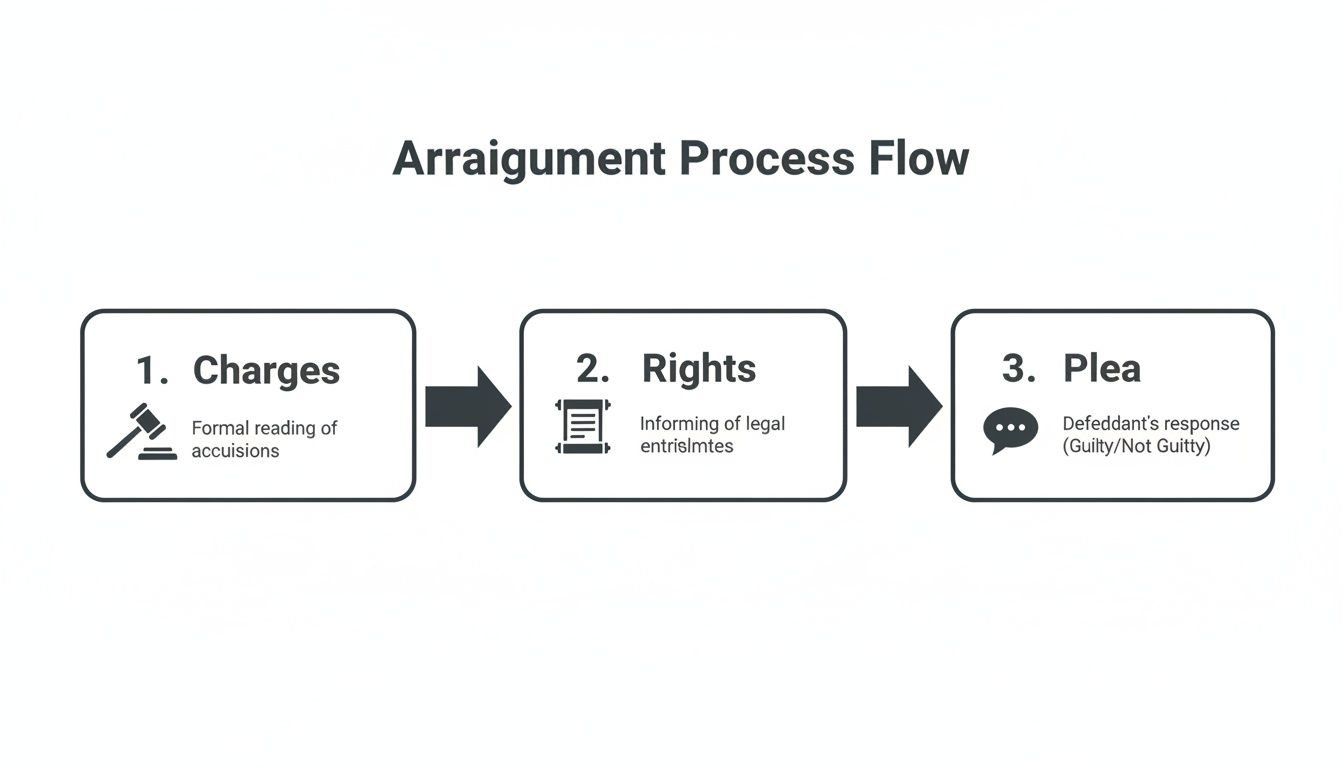
As the visual shows, everything flows logically: they tell you what you’re charged with, they explain your rights, and then they ask you for your plea.
Advisement Of Your Constitutional Rights
Right after reading the charges, the judge will explain your constitutional rights. This is one of the most critical moments of the entire hearing. Think of it as the “terms and conditions” for your legal case—you have to understand them before moving forward.
These rights are the bedrock of our justice system and include some major protections:
- The Right to Remain Silent: Anything you say can be used against you. This right protects you from incriminating yourself.
- The Right to an Attorney: You have a right to a lawyer at every single stage. If you can’t afford one, the court has to appoint one for you.
- The Right to a Trial: You have the right to a trial, either by a jury or just a judge, where the prosecutor has to prove you are guilty beyond a reasonable doubt.
- The Right to Confront Witnesses: You have the right to see the evidence and question the people brought in to testify against you.
The judge has to make sure you get it before they ask for your plea. This isn’t just a formality; it’s a crucial safeguard to ensure any decision you make is an informed one.
This is a crucial checkpoint. When you say you understand your rights, it has real legal weight. The court is officially confirming you have the basic knowledge needed to make your next move: entering a plea.
Entering Your Plea
Next up, the judge will ask the big question: “How do you plead?” You have to give an initial answer. In Michigan, the main options are Guilty, Not Guilty, or No Contest (which is also called nolo contendere).
Making this call on the fly, without a lawyer, is a huge gamble. Pleading “Not Guilty” is almost always the right move at an arraignment. It doesn’t mean you’re claiming you’re factually innocent right then and there. It simply hits the “pause” button, preserving all your legal rights and giving your attorney time to get the police reports, look at the evidence, and figure out a real strategy.
On the other hand, pleading “Guilty” or “No Contest” is like hitting the “fast forward” button straight to the end. You give up your right to a trial and move right to sentencing. It’s a permanent decision that should never be made without a defense attorney having reviewed every detail of your case first.
Determining Bail And Bond Conditions
The last major task of the arraignment is setting bail and bond conditions. The judge has to decide if you can be released while the case moves forward and, if so, what rules you’ll have to follow.
The prosecutor might push for a high bond or strict conditions, while your defense lawyer will argue for you to be released with the fewest restrictions possible. The judge weighs several things, like how serious the charge is, your criminal history, and your connections to the community (like a job or family). The main goal is just to make sure you show up for your future court dates.
Conditions can be anything from a simple promise to appear (a personal recognizance bond) to requiring a large cash payment to get out.
Understanding Your Plea Options And Their Consequences

When the judge finally looks at you and asks, “How do you plead?”—that’s it. That’s the most important moment of your arraignment. This isn’t just a routine question; your answer literally sets the course for everything that follows.
Making the wrong call here can shut down opportunities you didn’t even know you had. In Michigan, you’re generally given three choices for a misdemeanor charge, and believe me, they are not created equal.
The Standard Options: Pleading Guilty, Not Guilty, Or No Contest
The court will lay out what seems like a simple, multiple-choice question. But the legal gravity behind each answer is immense, and once you’ve said it, walking it back is next to impossible.
Here are the three pleas you’ll be offered:
- Not Guilty: This is a formal denial of the charges. It’s not you proclaiming your factual innocence on the spot. Instead, you’re telling the prosecutor, “If you want to convict me, you have to prove your case beyond a reasonable doubt.”
- Guilty: This is a complete admission to the crime. When you plead guilty, you’re giving up your constitutional right to a trial, your right to confront witnesses, and your right to remain silent.
- No Contest (Nolo Contendere): With this plea, you aren’t admitting you did it, but you are agreeing not to fight the charges. The court will sentence you just as if you pleaded guilty. Its main advantage is that it can’t be used against you as an admission of guilt in a related civil lawsuit.
Pleading “Guilty” or “No Contest” might feel like the fastest way to put this all behind you, but it’s almost always a major strategic blunder at this early stage. It’s like agreeing to buy a house without ever looking inside—you have absolutely no idea what problems you’re inheriting.
Why Pleading Not Guilty Is The Strategic Default
For virtually anyone facing a misdemeanor arraignment in Michigan, the smartest, safest, and most strategic move is to plead not guilty. This isn’t about starting an argument with the judge. It’s about protecting your rights and buying the time you need to build a real defense.
Think of pleading not guilty as hitting the “pause” button. It stops the case from hurtling toward an immediate conviction and sentence. That pause gives you and your attorney the critical breathing room to:
- Demand and review the evidence (discovery): This is where we get the police reports, witness statements, and any video or audio evidence the prosecutor plans to use against you.
- Find the weaknesses in their case: You can’t spot procedural mistakes by the police or holes in the prosecutor’s story until you see the evidence.
- Open the door for negotiations: Pleading not guilty gives your attorney the leverage to negotiate for a potential charge reduction or a favorable plea deal. If you plead guilty right away, you lose all that bargaining power.
Pleading not guilty is the only option that keeps all your legal doors open. It triggers the next step in the process, usually a pretrial conference, where the real work of fighting your case begins.
A guilty plea at arraignment is a final act. You forfeit your right to challenge anything the state has, and the judge will proceed directly to sentencing. That could happen right then and there or be set for a later date, but the end result is the same: a criminal conviction on your record without ever putting up a fight.
The fallout from that conviction can be huge, impacting your job, your housing, and any professional licenses you hold. For anyone wanting to understand the negotiation phase that a “not guilty” plea unlocks, you can learn more about how plea deals affect those charged with crimes and see why keeping this option on the table is so vital.
Bottom line: the arraignment is not the time to “just get it over with.” It’s the time to be smart, protect your future, and set yourself up for the best possible outcome. Pleading not guilty is how you do it.
How Michigan Courts Determine Bail And Bond Conditions
Once you’ve entered your plea, the judge’s attention immediately pivots to a critical question: what happens to you while your case works its way through the system? The decision on bail and bond conditions will dictate your freedom for the entire legal process. It’s easily one of the most impactful parts of a Michigan misdemeanor arraignment.
Let’s be clear—the court’s main goal here isn’t to punish you. Instead, the judge is performing a balancing act between two priorities: protecting the public and making sure you show up for your future court dates. To do this, they’ll set specific conditions for your release.
These conditions can be as simple as a promise to appear or as serious as a significant cash payment. This isn’t a random decision; it’s based on a specific set of factors laid out in Michigan law.
The Key Factors Michigan Judges Consider
When setting your bond, the judge or magistrate is essentially acting as a risk assessor. They’re weighing several different elements to figure out how likely you are to come back to court and whether you pose any threat to the community. Having an attorney who can frame these factors in the best possible light is a massive advantage.
Here’s what they’re looking at:
- Your ties to the community: Do you have a steady job? Family in the area? Do you own a home? Strong community connections make you look less like someone who would skip town.
- Your criminal history: The judge will definitely be looking at your record. If you have a history of missing court dates or a long list of prior offenses, you can expect much stricter bond conditions.
- The nature and seriousness of the offense: A charge like Operating While Intoxicated (OWI) will probably come with different conditions than a retail fraud charge. The more serious the alleged crime, the higher the bond is likely to be.
- Your potential danger to the public: If the charge involves any kind of violence or threats, the court’s concern for public safety will be high. This can lead to no-contact orders or other very restrictive conditions.
A good lawyer can emphasize your positive community connections and argue that you aren’t a flight risk, which could be the difference between walking out of court and having to post a high cash bond.
Personal Recognizance vs. Cash Bond
The outcome of the bond decision usually falls into one of two buckets. Understanding the difference is crucial because it directly impacts both your freedom and your wallet.
Personal Recognizance (PR) Bond: This is the best-case scenario. A PR bond means the court is releasing you based on your written promise to show up for all future court dates. You don’t have to pay a dime.
Cash or Surety Bond: This requires you to post a set amount of money to get out. If you can’t pay the full amount yourself, you might have to hire a bail bondsman. They typically charge a non-refundable fee (often 10%) to post the bond on your behalf.
The goal is always to secure a personal recognizance bond. Your lawyer will argue that your background and the details of the case are enough to guarantee you’ll be back in court. For a deeper look into how these options work, you can learn more about what bail is and what types of bonds can be used in Michigan.
Common Non-Monetary Bond Conditions
Even if you get a personal recognizance bond, the judge will almost always set non-monetary conditions you have to follow. If you violate any of them, your bond can be revoked, and a warrant will be issued for your arrest.
Some common conditions include:
- No-contact orders: You may be ordered to stay away from the alleged victim or anyone else involved in the case.
- Substance abuse testing: For OWI or any drug-related misdemeanor, random drug and alcohol testing is extremely common.
- Travel restrictions: The court might prohibit you from leaving the state without getting permission first.
- Abstaining from criminal activity: This is a given—you cannot be arrested for any new crimes while you’re out on bond.
These conditions aren’t suggestions; they are legally binding orders. The arraignment sets the ground rules for your release, and an experienced attorney’s job is to fight to make sure those rules are as fair and manageable as possible.
So, What Happens After The Arraignment?
Don’t make the mistake of thinking your case is over once the arraignment is done. It’s not. In fact, pleading “not guilty” is like firing the starting gun for the real work. The arraignment is just the setup; everything that comes next is where your attorney actually starts building your defense.
Once you walk out of the arraignment, your case shifts into a critical period of investigation and negotiation. The very next stop is almost always a pretrial conference. This isn’t some formal hearing in front of a judge—it’s a behind-the-scenes meeting between your lawyer and the prosecutor where they get down to business, review the evidence, and see if a resolution is possible.
The Pretrial Conference Is Where The Magic Happens
For most misdemeanor cases in Michigan, the pretrial conference is the main event. It’s the first chance for your attorney to get their hands on the police reports, any witness statements, and all the other evidence the prosecutor thinks they have against you. This “discovery” process is absolutely vital for poking holes in the state’s case.
The goal here? To get the best possible outcome without ever stepping foot in a trial. A lot can happen during these negotiations:
- The prosecutor might agree to a complete dismissal if the evidence is flimsy.
- You could be offered a plea bargain to a much less serious offense.
- Your lawyer and the prosecutor might reach an agreement on a specific sentence.
Honestly, the vast majority of misdemeanor cases are wrapped up at this stage. It’s rare for these cases to go all the way to a jury trial, which makes these pretrial talks incredibly important for how your case turns out.
Motions, Deadlines, and The Road to Trial
What if you can’t reach a deal at the pretrial? Then the case keeps moving forward. Your attorney might file motions to challenge how the police gathered evidence or to get certain testimony thrown out. These motions lead to separate court hearings where a judge listens to legal arguments and makes a ruling. For instance, if your lawyer can prove a traffic stop was illegal, any evidence found because of that stop could get suppressed.
After the arraignment, the clock starts ticking. The court sets a pretty strict schedule to keep things moving. For example, once you enter your plea, the judge will often set the first pretrial date within 35 to 42 days. These deadlines are crucial. You can learn more about how Michigan courts set these crucial timelines for misdemeanor cases.
If, after all the negotiations and motions, no plea agreement is reached, your case gets scheduled for trial. This is the final step, where the prosecutor has to prove your guilt beyond a reasonable doubt to a judge or jury. Seeing this entire roadmap from the very beginning helps you understand how every single decision—starting with that “not guilty” plea—shapes everything that follows.
A Few Common Questions About Michigan Arraignments
Even with a basic roadmap, it’s the specific “what-ifs” that keep people up at night. Let’s tackle some of the most common questions head-on to help clear the air.
Can I Actually Be Jailed at My Misdemeanor Arraignment?
It’s possible, but it’s not the main point of the hearing. The biggest risk of being taken into custody really boils down to two scenarios: you have an old, unrelated warrant for your arrest, or the judge sets a cash bond so high you can’t pay it on the spot.
For most standard misdemeanors, the goal is actually to set conditions for your release. This is one of the first places a lawyer makes a huge difference. Having an attorney there to argue for a personal recognizance bond (where you just sign a promise to return) or a fair, low cash bond drastically cuts down the odds of you seeing the inside of a jail cell.
Do I Really Need a Lawyer for a Misdemeanor Arraignment?
You have the right to go it alone, but I’ll be blunt—it’s a terrible idea. People who represent themselves are far more likely to make critical mistakes they can’t take back. They might plead guilty without realizing the case against them is weak or not understanding the conviction will follow them for years.
Think of an attorney as your shield from the very first minute. They are there to protect your rights, fight for a fair bond, and start positioning your case for the best possible outcome down the road.
What Happens If I Miss My Arraignment Date?
Missing your arraignment is one of the worst things you can do. If you don’t show up, the judge will almost certainly issue a bench warrant for your arrest.
What does that mean? It means any future run-in with law enforcement—even for something as simple as a broken taillight—will likely end with you in handcuffs. If you know you can’t make your court date, it is absolutely critical to call the court and an attorney immediately. They may be able to get it rescheduled and stop a warrant from ever being issued.
Navigating a misdemeanor charge takes a steady hand and a deep understanding of Michigan’s court system. The team at David G. Moore, Attorney at Law is here to provide the strategic defense you need from day one. Contact us today to schedule your consultation at https://dgmoorelaw.com.


